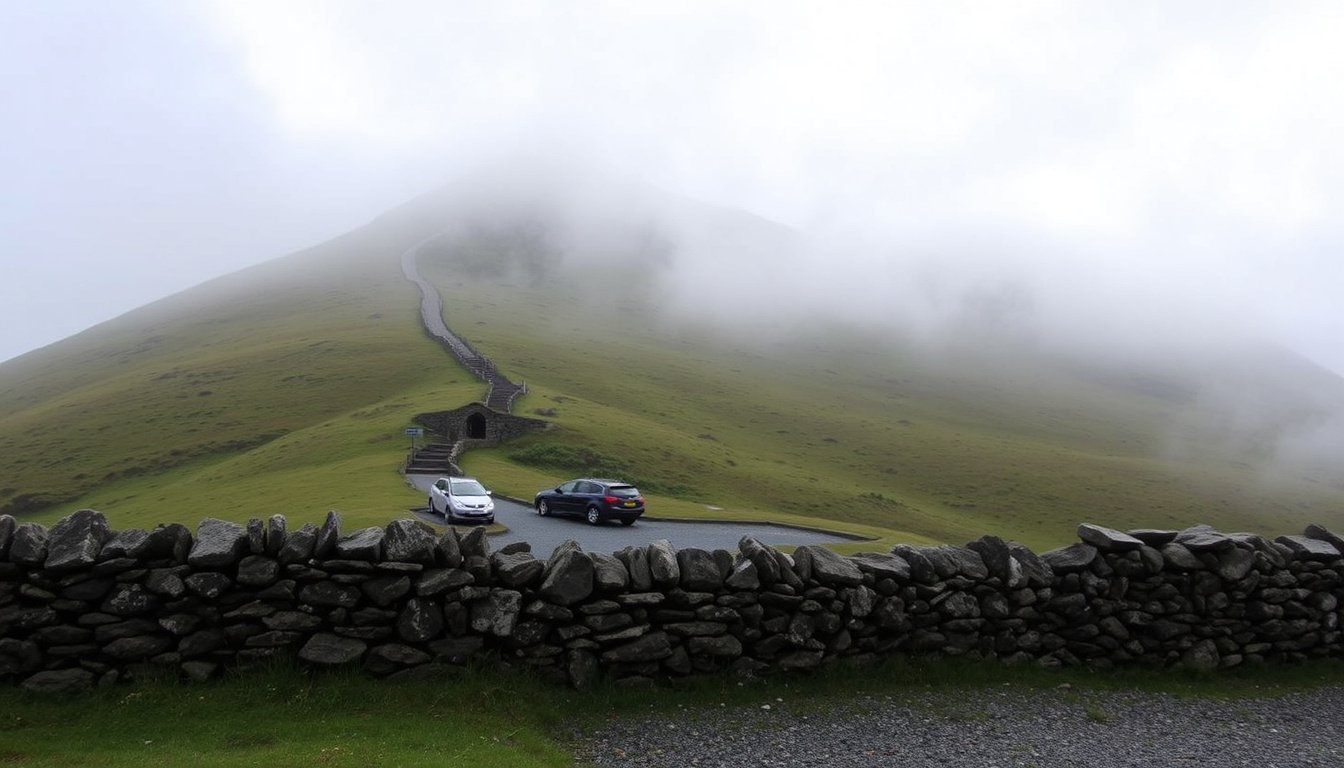
Rising to 451 metres above the shores of Derwentwater, Cat Bells is one of the most walked fells in the Lake District. Its popularity rests on a rare combination: a summit that feels genuinely mountainous yet remains accessible to walkers of modest fitness. The classic circular route covers roughly 3.5 miles and takes between two and three hours, but the experience is shaped less by distance than by the steep, rocky sections that require careful footing.
Cat Bells has drawn visitors for over a century. What began as a destination for Victorian tourists from nearby Keswick has become a fixture of the modern Lake District itinerary, drawing thousands each year. Its prominence in online searches — particularly for sunrise photography and family-friendly hiking — reflects a broader shift in how people engage with the UK’s national parks.
But the walk’s popularity comes with complications. Parking at the official start is notoriously limited, and illegal parking has become a documented safety concern. Understanding the route, the alternatives, and the history behind the name helps visitors plan a trip that matches expectations.
What is the Cat Bells Walk Route and How Long Does It Take?
| Height 451 m (1,480 ft) |
Distance (Circular) 3.5 miles (5.6 km) |
| Typical Duration 2–3 hours |
Difficulty Moderate / Beginner Friendly |
- Cat Bells is consistently rated one of the most accessible fells in the Lake District for first-time hikers.
- The official car park at Skelgill Bank holds only about 10 cars, making parking the primary logistical challenge.
- The name ‘Cat Bells’ combines Old Norse (‘kjǫttr’ for ‘wild cat’) and Cumbrian dialect (‘bells’ for ‘mountain peak’).
- Illegal parking on double yellow lines near the start has been documented as a recurring problem that blocks emergency vehicles.
- The sunrise walk is a top search query, indicating strong interest in early-morning hiking and photography.
- The Park and Sail option at Keswick Rugby Club offers 200 spaces and a boat connection, bypassing the main car park bottleneck.
- Cat Bells has been a popular destination since the 19th century, when Victorian tourists began visiting from Keswick.
| Feature | Detail |
|---|---|
| Location | English Lake District, near Keswick, Cumbria |
| Grid Reference | NY 244 198 |
| Prominence | 90m (295 ft) |
| Parent Peak | Dale Head |
| Start Points | Hawes End, Little Town, Keswick |
| Dog Friendly | Yes (with caution on scrambles) |
| Bus Service | Honister Rambler (78/77A) stops near Cat Bells |
The Classic Circular Route from Hawes End
The most commonly described route begins at the foot of Skelgill Bank, near Brandelhow Bay. From there, the path climbs steeply up Skelgill Bank to the summit at 451 metres. After taking in the views of Derwentwater, walkers descend to the saddle of Hawes Gate and loop back through a plantation of conifers and along the lakeshore, passing old mine workings. This circular route is the one most guides recommend for first-time visitors.
Distance and Duration: 3.5 Miles / 2–3 Hours
Sources consistently report the circular walk as roughly 3.5 miles, with a typical completion time of two to three hours. The actual time depends on fitness level, the number of stops, and weather conditions. The path levels briefly before the final climb, offering a short respite before the summit push. The descent includes rocky sections that require the same care as the ascent.
Alternative Routes: From Keswick and Grange
Walkers based in Keswick can reach Cat Bells via the lakeshore path, adding distance but avoiding the need to drive to the start. Another option begins from Grange, approaching from the eastern edge of the fell. These alternatives are less frequently described in official guides but offer quieter conditions, particularly on busy weekends. The Keswick Tourism walking route provides a useful map for planning.
Where Do You Park for the Cat Bells Walk (And Other Logistics)?
Primary Car Parks: Hawes End & Little Town
The official car park at the foot of Skelgill Bank is tiny — approximately 10 spaces — and fills up quickly, especially on weekends and in good weather. Arriving early is essential if you plan to park there. The Newlands Institute Car Park near Ling Home offers an alternative, with a cost of around £3, and is described as easier to find a spot in and quieter than the official start, though still limited.
Parking Challenges & Alternatives (Bus, Boat)
Parking is the primary challenge for Cat Bells visitors, and the problem has a documented history. Drivers have repeatedly parked illegally on double yellow lines near Skelgill Bank, and while enforcement has been inconsistent, the practice blocks fire engines, ambulances, and mountain rescue vehicles. The Lake District National Park Authority advises parking responsibly and ensuring emergency vehicles have room to pass.
Illegal parking on double yellow lines near the Cat Bells start has been a recurring issue. Local sources report that this has blocked fire engines, ambulances, and mountain rescue vehicles. Despite inconsistent enforcement, the practice remains dangerous and is strongly discouraged by the Lake District National Park Authority.
The Park and Sail option at Keswick Rugby Club on Crow Park Road offers 200 spaces and includes a 15% discount on the Keswick Launch boat ticket to Hawes End. The boat provides access to the southern ascent route, which is a popular alternative to the steep northern climb. The Honister Rambler bus service also stops near Cat Bells, providing another way to avoid the parking crunch.
Keswick Rugby Club offers 200 parking spaces and a discounted boat ticket to Hawes End. This avoids the stress of the 10-space Skelgill Bank car park entirely and is widely recommended by local tourism sources for peak-season visits.
Best Time to Walk for Sunrise & Avoiding Crowds
The best strategy for a quiet experience is to arrive very early — before 8 a.m. — or to go mid-week and out of season. Sunrise walks are particularly popular among photographers, and the fell’s eastern-facing position over Derwentwater makes it a natural choice for early-morning light. However, sunrise times and crowd levels vary significantly by season, and no single ‘best time’ guarantee exists.
What is the Origin of the Name ‘Cat Bells’?
The ‘Cat’ in Cat Bells: A Possible Norsemen Connection
The name ‘Cat Bells’ is a combination of two linguistic traditions. The ‘Cat’ element may derive from the Old Norse word ‘kjǫttr,’ meaning ‘wild cat,’ referring to the wildcats that once inhabited the Lake District. Another possibility is that ‘cat’ comes from an Old Norse word meaning ‘battle,’ suggesting the site may have been used as a beacon or skirmish location. Both interpretations remain plausible, and no definitive evidence settles the question.
Linguists and local historians agree that the ‘cat’ element could refer to wild cats or to a battle site. Both interpretations have scholarly support, and the name’s exact origin may never be confirmed with certainty.
Bells: Meaning ‘Peak’ or ‘Mountain’ in Cumbrian Dialect
The second part of the name, ‘Bells,’ is more straightforward. In the Cumbrian dialect, ‘bells’ is understood to mean ‘mountain’ or ‘peak.’ This is consistent with the names of other local fells and reflects the region’s distinct linguistic heritage. The Wikipedia entry for Cat Bells notes the fell’s height of 451 metres and its status as one of the most popular fells in the Lake District.
Height & Location: 451m in the Lake District
Cat Bells stands at 451 metres (1,480 feet) above sea level, with a prominence of 90 metres. Its parent peak is Dale Head. The fell is located near Keswick in Cumbria, on the western shore of Derwentwater, within the Lake District National Park. Its grid reference is NY 244 198.
Is Cat Bells Suitable for Families and Beginners?
Why Cat Bells is Considered a Beginner-Friendly Fell
Cat Bells is widely described as a relatively easy walk and a classic ‘first fell’ for newcomers to the Lake District. Its short distance and moderate elevation make it achievable for most people with basic fitness. Some sources call it an “easy hike” for those accustomed to walking, and the TripAdvisor reviews frequently describe it as a rewarding walk that doesn’t require advanced skills.
Challenging Sections: Short Scrambles Near the Summit
Despite its beginner-friendly reputation, Cat Bells includes sections of genuine scrambling. The steep initial climb up Skelgill Bank and the rocky sections near the summit require the use of hands in places. Some sources warn that the scrambling makes the walk unsuitable for the “faint-hearted.” In wet conditions, these sections become slippery, and sturdy walking boots are strongly recommended. In dry weather, trainers may suffice, but walking boots provide better grip on the exposed rock.
Safety Tips for Walking with Children on Cat Bells
Families with children can enjoy Cat Bells, but the scrambling sections require close supervision. Dogs are permitted but should be kept on leads near the summit scrambles and on narrow paths. There are no toilets at the start of the walk; the nearest facilities are in Keswick or at the Derwentwater launch. The Hiking Photographer’s guide provides additional detail on the route and its challenges.
How Has Cat Bells Evolved as a Visitor Destination?
- Prehistoric/Medieval: The fell was likely used as a beacon site, and local folklore suggests wild cat habitation in the area.
- 19th Century: Cat Bells became a popular destination for Victorian tourists visiting from Keswick.
- 20th Century: The walk solidified its reputation as a classic ‘first fell’ for Lake District visitors.
- 2019–2024: A surge in popularity led to parking restrictions and the introduction of shuttle services to manage high traffic.
What Is Known and What Remains Uncertain About Cat Bells?
| Established Information | Information That Remains Unclear |
|---|---|
| Cat Bells is 451m high and located in the Lake District. | Name origin: ‘Cat’ may refer to wild cats (likely) or a battle site (‘cat’ meaning battle in Old Norse) – both are possible. |
| The circular walk from Hawes End is approximately 3.5 miles. | Sunrise times and crowd levels vary significantly by season; no single ‘best time’ guarantee exists. |
| Parking is extremely limited at the base of the walk. | The exact frequency of parking enforcement at Skelgill Bank is not consistently documented. |
Why Is Cat Bells Considered a Gateway Fell?
Cat Bells occupies a specific niche in the Lake District walking scene. It is accessible enough for a family with children, yet it includes sections that require scrambling and careful footing. This combination makes it a ‘gateway’ fell — a walk that introduces newcomers to the feel of real mountain terrain without demanding a full day’s commitment or advanced skills. Compared to nearby alternatives such as Latrigg, which is gentler, or Causey Pike, which is more technical, Cat Bells offers a middle ground that balances challenge and reward. Its popularity on social media, particularly Instagram posts featuring sunrise light over Derwentwater, has contributed to rising visitor numbers and placed additional pressure on local infrastructure.
What Do Official Sources Say About Cat Bells?
“Cat Bells is one of the most popular fells in the Lake District for over a century.”
— Keswick Tourism
“Parking is extremely limited; plan ahead and use the bus or boat.”
— Lake District National Park Authority
“Cat Bells has a height of 451 metres (1,480 ft) and is one of the most popular fells in the Lake District.”
— Wikipedia
“Cat Bells is a relatively easy walk… low, easy to conquer.”
— Bit About Britain
What Is the Best Way to Experience Cat Bells?
The most reliable approach is to plan ahead. Arriving early, using the Park and Sail option, or taking the Honister Rambler bus removes the stress of finding a parking space. The classic circular route from Hawes End offers the best balance of views and manageable difficulty. For those interested in the broader context of UK travel, Capsule hotels in Britain: efficient innovation or cramped compromise? provides a look at another side of British tourism. Meanwhile, Lufthansa Airlines – A Complete Guide for Travelers offers practical advice for those planning further travel from the UK.
Frequently Asked Questions
Is Cat Bells suitable for dogs?
Yes, but keep dogs on leads near the summit scrambles and on narrow paths.
Are there toilets at Cat Bells?
No toilets at the start; nearest facilities are in Keswick or at the Derwentwater launch.
Can you walk Cat Bells in trainers?
In dry weather, yes. In wet or winter conditions, sturdy walking boots are strongly recommended.
Is there a pub near Cat Bells?
Yes, the Swinside Inn is a popular stop near the Little Town starting point.
How long does the Cat Bells circular walk take?
Most walkers complete the 3.5-mile route in 2 to 3 hours, depending on pace and conditions.
Is Cat Bells harder than Latrigg?
Yes, Cat Bells is more challenging due to its steep sections and scrambling, while Latrigg is gentler.
What is the best time of year to walk Cat Bells?
Spring and autumn offer mild weather and fewer crowds. Summer weekends are the busiest.
Do I need a map for Cat Bells?
A map is helpful, especially for alternative routes. The OS Explorer OL4 map covers the area.
Can I park at the Cat Bells car park overnight?
The Skelgill Bank car park is small and not designed for overnight stays. Check local signage.
Is there mobile phone reception on Cat Bells?
Reception is generally good on the summit but can be patchy in the lower sections and valleys.

Oliver Arthur Morgan Harrison is a staff writer for StoryShift.uk, covering UK news, culture, politics and technology. He works under Editor-in-Chief Maarika Tamm and UK Managing Editor Oliver Grant, following the newsroom standards for sourcing, verification and fact-checking set out in our editorial policies.