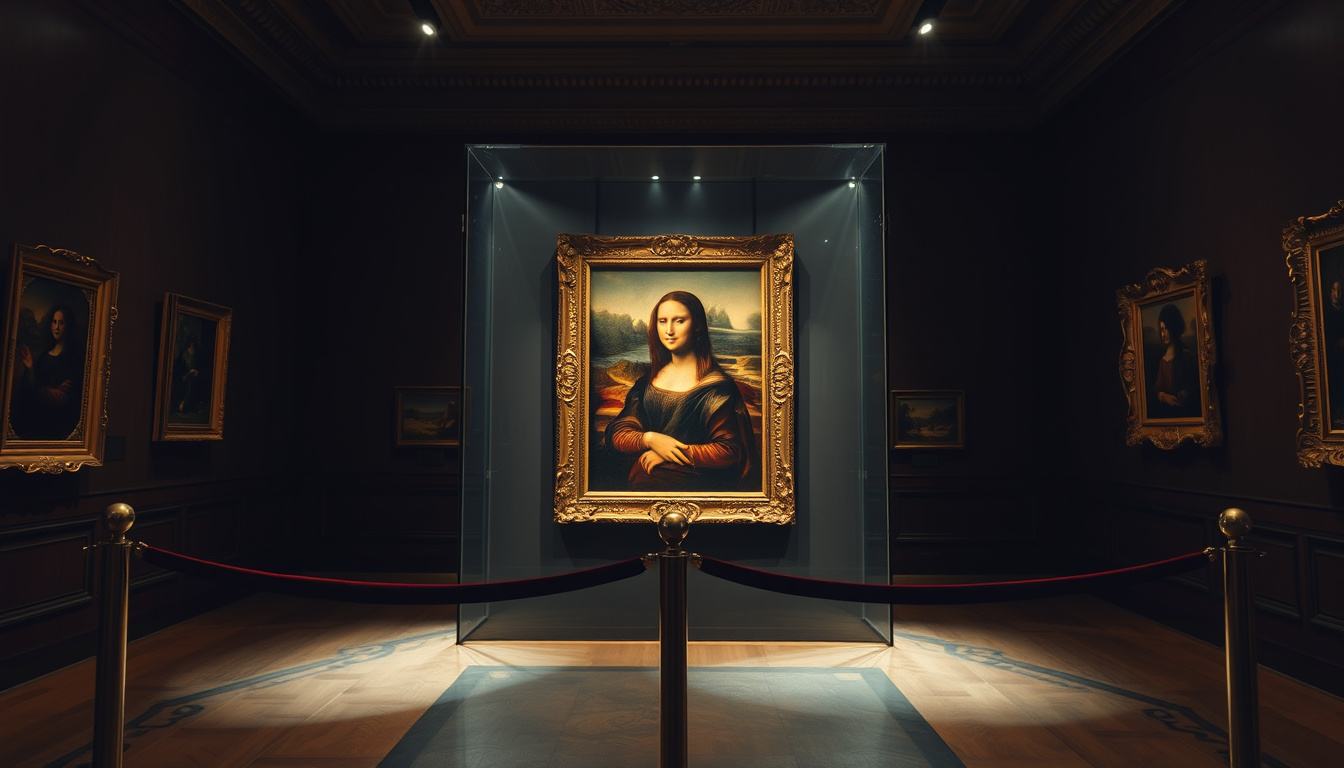
Each year, millions of visitors file through the Louvre Museum in Paris to spend a few seconds in front of a single painting. The woman in the portrait, seated against a hazy landscape, returns their gaze with a faint, elusive smile. This is the Mona Lisa, arguably the most recognised image in art history. Its renown, however, was not immediate. The painting’s journey from a respectable Renaissance commission to a global celebrity is the result of a series of events that began more than five centuries ago.
Painted by Leonardo da Vinci on a modest poplar panel measuring 77 by 53 centimetres, the portrait is generally believed to depict Lisa Gherardini, the wife of Florentine silk merchant Francesco del Giocondo. Leonardo likely began working on it around 1503 and continued intermittently until 1519, the year of his death. Today the Mona Lisa hangs behind bulletproof glass in the Louvre’s Salle des États, drawing crowds that queue for hours. Its fame, as Britannica notes, is not due to a single cause but to a combination of factors – Leonardo’s mastery, the sitter’s mystery, a spectacular theft, and endless cultural reproduction.
Why Is the Mona Lisa So Famous?
Painting
Oil on poplar panel, 77 cm × 53 cm, by Leonardo da Vinci, c. 1503–1519.
Subject
Lisa Gherardini, wife of Francesco del Giocondo, a Florentine silk merchant.
Location
Musée du Louvre, Paris, France – Room 711 (Salle des États).
Fame
World’s most famous painting due to its smile, theft in 1911, and endless media references.
Key Insights
- The Mona Lisa‘s fame is not primarily due to its artistic quality but to a perfect storm of theft, mystery, and mass reproduction. The 1911 theft made headlines globally; the empty space on the Louvre wall became a tourist attraction.
- The identity of the sitter is virtually certain – Lisa Gherardini – confirmed by a 2005 discovery of a note in a Florentine manuscript. Agostino Vespucci’s marginal note from 1503 names Lisa del Giocondo, matching da Vinci’s work records.
- The famous smile is an optical illusion achieved through sfumato – a technique that blends tones and softens edges. Neuroscience studies show that peripheral vision makes the smile appear more pronounced when looking away.
- Leonardo may never have delivered the painting to the Giocondo family, continuing to work on it until his death in France.
- The painting is considered priceless. A 1962 insurance valuation of $100 million is often cited as roughly $1 billion or more in later-value terms.
- The Louvre has housed the work since 1797, and it has been displayed behind bulletproof glass since 2005.
- Modern technology, including infrared scans, has revealed underpainting and revisions, adding another layer to the painting’s mystique.
Snapshot Facts
| Attribute | Value |
|---|---|
| Full Title | Ritratto di Monna Lisa del Giocondo (Portrait of Madam Lisa Giocondo) |
| Artist | Leonardo da Vinci |
| Year | c. 1503–1519 (continuous work) |
| Medium | Oil on poplar panel |
| Dimensions | 77 cm × 53 cm (30 in × 21 in) |
| Location | Louvre Museum, Paris (since 1797) |
| Subject | Lisa Gherardini (1479–1542) |
| Theft | Stolen 21 August 1911, recovered in 1913 in Florence |
| Value | Estimated over $800 million (uninsurable; considered priceless) |
Who Was the Real Mona Lisa? (Lisa Gherardini)
The woman behind the smile has a name, and it is not at all mysterious. Lisa Gherardini was born in Florence in 1479 into a modest noble family. Her father was a wool and silk merchant, and the family owned some agricultural land. In 1495, at the age of sixteen, Lisa married Francesco del Giocondo, a successful silk merchant who was twice her age. The marriage was likely arranged, but it proved stable and productive: the couple had at least five children.
Was the Mona Lisa Based on a Real Person?
Yes, the evidence is strong. In 2005, a scholar at the University of Heidelberg discovered a marginal note written by Agostino Vespucci, a Florentine clerk, in 1503. The note explicitly states that Leonardo da Vinci was working on a portrait of Lisa del Giocondo. This find, preserved in a manuscript now held in Heidelberg, is considered the strongest documentary evidence linking the Mona Lisa to the real Lisa Gherardini.
The 2005 discovery of Vespucci’s note in a Florentine manuscript is the closest thing to a smoking gun in art attribution. It confirms that the sitter is Lisa del Giocondo and was written while Leonardo was actively painting the portrait.
When Was Mona Lisa Born and How Did She Die?
Lisa Gherardini was born on 15 June 1479 in Florence. She died on 15 July 1542 at the age of 63. She was buried in the convent of Sant’Orsola in Florence, where she had spent her final years as a nun after her husband’s death. Her remains have never been definitively identified.
What Did the Real Mona Lisa Look Like?
No contemporary portraits of Lisa Gherardini survive aside from Leonardo’s painting. Digital reconstructions based on the Mona Lisa have been attempted, but they rely on the painting itself and cannot be independently verified. Historical descriptions from her lifetime are scarce and do not provide enough detail for a reliable reconstruction of her face.
Is the Louvre’s Mona Lisa the Real Original Painting?
The version hanging in the Louvre Museum is universally accepted by mainstream scholarship as the original painting by Leonardo da Vinci. It has been in the French royal and then national collection for centuries, and its provenance is unbroken.
Where Is the Original Mona Lisa Painting?
The original Mona Lisa is in the Musée du Louvre in Paris. It has been part of the Louvre’s collection since 1797, though it had been in the French royal collection since Leonardo’s arrival at the court of Francis I around 1516. The painting is now displayed in a climate-controlled, bulletproof-glass enclosure in the Salle des États.
Are There Other Versions of the Mona Lisa?
Several copies and variants exist, the most famous being the one held by the Prado Museum in Madrid, which was likely painted by a pupil of Leonardo. The Mona Lisa Foundation, a private organisation, has argued that an earlier version of the painting, known as the Isleworth Mona Lisa, is also by Leonardo. This claim is not supported by the majority of art historians and remains highly contentious.
How Much Is the Mona Lisa Worth?
The painting is considered priceless and has never been sold. In 1962, it was insured for $100 million during a tour to the United States. Adjusted for inflation, that figure is often cited as roughly $800 million to over $1 billion in today’s terms. No modern insurance valuation exists because the work is considered uninsurable and is not for sale.
The Louvre’s Mona Lisa is the only version with an unbroken provenance back to Leonardo. The Isleworth Mona Lisa, a larger version on canvas, is promoted by the Mona Lisa Foundation as an earlier original, but this has not been accepted by the mainstream art-historical community. The evidence for the Louvre version includes documentary records from the French royal collection and consistent scholarly consensus.
What Happened During the Mona Lisa Theft of 1911?
On the morning of 21 August 1911, the Mona Lisa was discovered missing from the Louvre. The theft was not noticed until the following day, when a painter arrived to work in the gallery and found only four iron pegs where the painting had hung. The crime became an international sensation almost immediately.
Who Stole the Mona Lisa?
The thief was Vincenzo Peruggia, an Italian handyman who had worked at the Louvre. He had hidden in a storeroom overnight, removed the painting from its frame, wrapped it in his smock, and walked out of the museum. The empty space on the wall became a tourist attraction in its own right, drawing more visitors than the painting had before.
How Was the Mona Lisa Recovered?
Peruggia kept the painting in a trunk in his Paris apartment for more than two years. In December 1913, he travelled to Florence and attempted to sell it to the director of the Uffizi Gallery. The director alerted the police, who arrested Peruggia. The painting was exhibited in Florence for a short time before being returned to the Louvre in 1914. Peruggia claimed he had stolen the work to return it to Italy, though he also reportedly sought a ransom.
Before 1911, the Mona Lisa was a respected Renaissance portrait but not yet a global icon. The theft generated unprecedented international publicity, and the empty wall became a spectacle. When the painting was recovered, its fame was already enormous – and it has only grown since. Many art historians argue that the theft was the single most important event in transforming the Mona Lisa into the world’s most famous painting.
What Is the History of the Mona Lisa Painting?
The history of the Mona Lisa stretches across five centuries, from Renaissance Florence to the climate-controlled gallery of the modern Louvre. Below is a timeline of the key moments in its journey.
- 1503–1506: Leonardo begins painting the portrait of Lisa Gherardini in Florence.
- 1516–1519: Leonardo brings the painting to France; continues working on it until his death.
- 1519: Painting enters French royal collection under King Francis I.
- 1797: Painting placed in the Musée du Louvre after the French Revolution.
- 21 Aug 1911: Mona Lisa stolen by Louvre employee Vincenzo Peruggia.
- 1913: Peruggia arrested in Florence; painting recovered and returned to Louvre.
- 1956: Vandalism attacks: acid thrown and rock thrown (minor damage).
- 2005: Note of Agostino Vespucci discovered, confirming sitter’s identity.
- 2019: Louvre installs bulletproof glass enclosure; climate-controlled room.
For more on the theft, the History Channel has a detailed account of Peruggia’s crime and capture.
What Do We Know for Certain About the Mona Lisa?
Some facts about the Mona Lisa are firmly established, while others remain matters of debate. The table below separates the certainties from the uncertainties.
| Established Information | Information That Remains Unclear |
|---|---|
| Painting is by Leonardo da Vinci. | Exact start and completion dates are debated (1503–1519 range). |
| Subject is Lisa Gherardini (confirmed by 2005 discovery). | Whether Leonardo continued the painting in France or finished it in Italy. |
| It was painted in Florence, later brought to France. | The meaning of the smile – intentional ambiguity or technique. |
| It was stolen in 1911 and recovered in 1913. | The identity of the landscape in the background (possibly Valdarno or imaginary). |
| The painting is in the Louvre and has been since 1797. | Whether the Mona Lisa in the Louvre is the only original – the Mona Lisa Foundation argues for an earlier version. |
Why Does the Mona Lisa Continue to Captivate the World?
The Mona Lisa continues to hold the world’s attention for reasons that go beyond art appreciation. The 1911 theft transformed it from a respected Renaissance portrait into a global celebrity. The theft created a story that the public could follow – an international mystery with a captive, silent protagonist. The painting’s absence from the Louvre wall was as powerful as its presence.
The sitter’s smile and gaze also contribute to its enduring magnetism. As art historian E.H. Gombrich observed, the smile is not a statement but a question. It invites endless interpretation. Modern technology has deepened this fascination: infrared scans and scientific analysis at the CNRS have revealed underpainting and compositional changes that suggest Leonardo revised the work substantially. Each new discovery adds a fresh chapter to the painting’s story.
Infinite reproductions in memes, advertising, and pop culture have kept the image omnipresent. The Mona Lisa is not only seen in museums; it is encountered everywhere, from coffee mugs to digital screens. This constant visibility, layered over the real painting in the Louvre, creates what one might call a cultural feedback loop: the more it is reproduced, the more people want to see the original.
What Do Experts Say About the Mona Lisa?
Giorgio Vasari, writing in 1550, described the smile in terms that have echoed for centuries. More recent voices have offered their own interpretations of the painting’s power.
“The Mona Lisa is the only painting that you have to queue to see, yet it is the most reproduced image in the world.”
Art critic Martin Gayford, quoted in The Telegraph
“The smile is not a statement; it is a question.”
Professor E.H. Gombrich, art historian
“That contraction of the mouth, or smile, is a thing that is so pleasing that it seems rather divine than human.”
Giorgio Vasari, The Lives of the Most Excellent Painters, 1550
For a broader understanding of Leonardo da Vinci’s life and other works, see our guide to Leonardo da Vinci: Life and Masterpieces.
What Is the Lasting Legacy of the Mona Lisa?
The Mona Lisa is more than a painting. It is a cultural artifact that has survived theft, vandalism, and centuries of scrutiny to retain its hold on the global imagination. Its legacy lies not only in its artistic qualities – the sfumato technique, the composition, the enigmatic expression – but in the story of how a single portrait became a universal symbol. For those who want to explore the most celebrated works of art in history, our list of Top 10 Most Famous Paintings in the World provides further context. For more on the painting’s history and the 1911 theft, Wikipedia’s comprehensive entry and Britannica’s authoritative summary offer detailed accounts.
Frequently Asked Questions About the Mona Lisa
Where is the Mona Lisa located today?
The Mona Lisa is housed in the Musée du Louvre in Paris, in a dedicated room (Salle des États).
Is the Mona Lisa the most expensive painting in the world?
While uninsured, it is considered priceless. The highest insured value was $100 million in 1962 (equivalent to $800+ million today), but it is not sold.
How long did it take Leonardo to paint the Mona Lisa?
He worked on it intermittently from about 1503 to 1519 – roughly 16 years.
What does ‘Mona Lisa’ mean?
‘Mona’ is an Italian contraction of ‘madonna’ (my lady); ‘Lisa’ refers to Lisa Gherardini. So ‘Mona Lisa’ means ‘Lady Lisa’.
Has the Mona Lisa been damaged?
Yes, minor damage: an acid attack in 1956 damaged the lower part, and a rock thrown in 1956 chipped the frame. It was restored.
Can I see the Mona Lisa online?
Yes, the Louvre offers a high-resolution zoomable image on its website, as well as a virtual tour.
What is the Mona Lisa Foundation?
The Mona Lisa Foundation is a private organisation that claims an earlier version of the painting, the Isleworth Mona Lisa, is also by Leonardo. This claim is disputed by mainstream scholars.
Is the Mona Lisa’s smile unique in art?
No, but it is exceptionally subtle. Leonardo’s sfumato technique blends tones so softly that the smile seems to shift when viewed directly versus peripherally.
Did Leonardo paint the Mona Lisa in France?
He began it in Florence around 1503 and brought it to France in 1516, where he may have continued working on it until 1519.
How many people see the Mona Lisa each year?
Approximately 10 million visitors pass through the Louvre annually, and a large majority stop to see the Mona Lisa.

Oliver Arthur Morgan Harrison is a staff writer for StoryShift.uk, covering UK news, culture, politics and technology. He works under Editor-in-Chief Maarika Tamm and UK Managing Editor Oliver Grant, following the newsroom standards for sourcing, verification and fact-checking set out in our editorial policies.