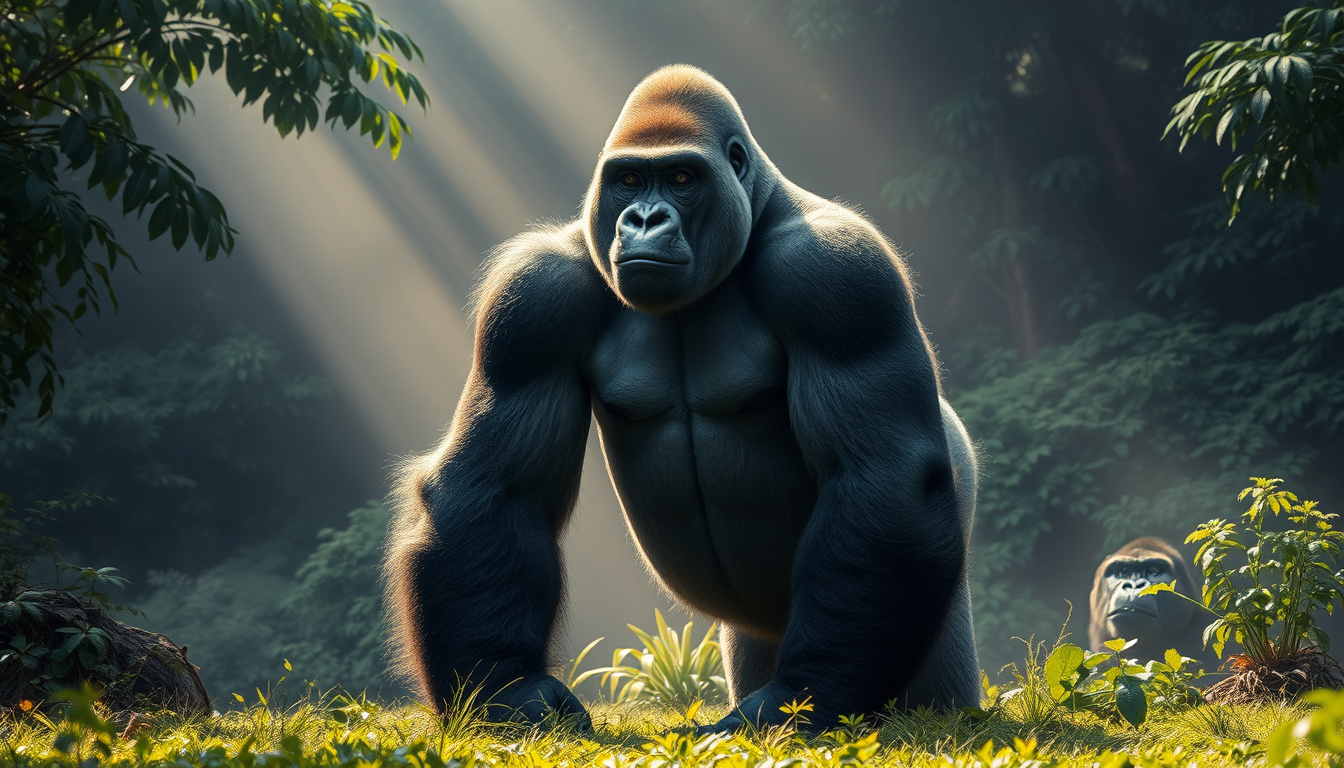
A silverback gorilla is the dominant adult male of a gorilla group, representing the largest living primate species on Earth. For mountain gorillas, a subspecies of the eastern gorilla, these males are commonly cited at about 180–200 kg (roughly 400–430 lbs) and stand around 1.5–1.8 m tall when upright. Their name comes from the distinctive saddle of silver-gray hair that develops on their backs as they mature, a visible marker of experience and leadership.
These powerful primates live in the dense montane and bamboo forests of Central Africa, primarily within the Virunga Massif and Bwindi Impenetrable National Park. Their social structure revolves around a single dominant silverback who leads, protects, and mediates the group. Despite their formidable size, silverbacks are primarily herbivorous, feeding on leaves, stems, and fruit, and they play a vital role in seed dispersal within their ecosystem.
Conservation status for mountain gorillas remains a high priority. They are classified as endangered and remain dependent on intensive protection efforts. Habitat loss, poaching, and disease continue to threaten their populations, though dedicated conservation work has helped stabilize numbers in recent decades.
How Much Does a Silverback Gorilla Weigh and How Tall Are They?
- Silverback gorillas are the largest living primates, with males reaching up to 195 kg (about 429 lb).
- Despite massive strength, they are generally gentle and herbivorous, eating mainly leaves, stems, and fruit.
- Their habitat is limited to dense forests in Central Africa; the population remains under threat from poaching and disease.
- The iconic “silverback” name comes from the saddle of silver hair that appears on mature males’ backs.
- Silverbacks lead and protect family groups that include females, offspring, and sometimes subordinate males.
- Mountain gorillas remain endangered and conservation-dependent, with around 1,000 individuals estimated in the wild.
- Their lifespan in the wild commonly ranges from 35 to 50 years, depending on protection and environmental conditions.
| Attribute | Value |
|---|---|
| Scientific Name | Gorilla beringei (eastern) / Gorilla gorilla (western) |
| Average Weight (male) | 400–430 lbs (180–195 kg) |
| Average Height (standing) | 5.5–6 ft (1.65–1.83 m) |
| Arm Span | Up to 8.5 ft (2.6 m) |
| Diet | Herbivorous (leaves, stems, fruit) |
| Habitat | Tropical rainforests of Central Africa (Uganda, Rwanda, DRC, etc.) |
| Conservation Status | Mountain gorilla: Endangered; Eastern lowland: Critically Endangered |
How Strong Is a Silverback Gorilla?
Silverback gorillas are renowned for their extraordinary strength, often described by conservation sources as more than ten times stronger than an average human. Some reports estimate that a silverback may be capable of lifting over 800 kg of dead weight, though these figures are based on muscle mass calculations and anecdotal observation rather than controlled scientific measurement. As noted by Virunga National Park, their physical power is primarily used for display, group defense, and maintaining social dominance, not for aggression against other species.
Strength Compared to Humans
The widely repeated claim that a silverback is 10 times stronger than a human is not backed by direct experimental data. It originates from comparative estimates of muscle fiber density, body mass, and observed feats such as bending iron bars and uprooting vegetation. The International Fund for Animal Welfare describes gorillas as possessing immense strength relative to their size, but precise pound-for-pound comparisons remain uncertain.
Can a Silverback Gorilla Lift a Car?
No verified instance exists of a silverback lifting a car. While their raw strength is considerable, statements about lifting vehicles are speculative. The available evidence from conservation sources suggests that such claims are exaggerated and not grounded in observed behavior or controlled testing.
No scientific study has directly measured the maximum lifting capacity of a silverback gorilla. All current figures — including the “10x human strength” and “800 kg lift” estimates — are inferred from muscle mass analysis and isolated anecdotal reports. They should be treated as approximations rather than established facts.
Silverback Gorilla vs Grizzly Bear: A Factual Comparison
Comparisons between a silverback gorilla and a grizzly bear are common in online discussions, but they are entirely hypothetical. No such confrontation has ever been observed or documented by scientists. According to analysis from wildlife comparison sources, the most significant factor is body mass: adult male grizzly bears typically outweigh silverback gorillas by a considerable margin.
Size and Mass Differences
A full-grown silverback gorilla weighs about 300–430 lb, while adult male grizzlies are significantly heavier, often exceeding 600 lb. This size disparity gives the grizzly a major advantage in any direct physical encounter. The gorilla’s strength is impressive, but the bear’s mass, claws, and bite force place it in a different weight class entirely.
Behavioral and Ecological Context
Beyond physical comparisons, the two species occupy completely different habitats and ecological niches. Silverback gorillas are social primates living in forest family groups, while grizzly bears are solitary omnivores inhabiting North American wilderness. A confrontation between them would be unnatural and has no basis in real-world ecology.
Claims about the outcome of a fight between a silverback gorilla and a grizzly bear are speculative. No scientific data exists to support any conclusion. The grizzly’s larger body mass and natural weaponry (claws and bite) suggest a size advantage, but such comparisons remain in the realm of entertainment, not biology.
Where Do Silverback Gorillas Live? Habitat and Range
Silverback gorillas inhabit the tropical montane and bamboo forests of Central Africa. For mountain gorillas, the range is concentrated in two main locations: the Virunga Massif (spanning Rwanda, Uganda, and the Democratic Republic of the Congo) and Bwindi Impenetrable National Park in Uganda. These high-altitude forests provide the vegetation that forms the bulk of their diet. The World Wildlife Fund notes that habitat loss remains a persistent threat, as agricultural expansion and human settlement encroach on protected areas.
Countries and Protected Areas
Mountain gorillas are found in three countries: Rwanda, Uganda, and the Democratic Republic of the Congo. National parks and protected reserves are critical to their survival. Eastern lowland gorillas, a separate subspecies, inhabit lowland tropical forests in the eastern DRC. Their populations are even more fragmented and face greater threats from conflict and mining.
Altitude and Forest Type
Mountain gorillas live at elevations between 2,200 and 4,300 meters. The forests are characterized by dense undergrowth, bamboo stands, and abundant herbaceous plants. This environment provides both food and shelter, but it also isolates populations, making them vulnerable to genetic bottlenecks and disease outbreaks.
Despite ongoing threats, mountain gorilla numbers have increased from a low of around 600 individuals in the 1980s to an estimated 1,000 today. This recovery is attributed to intensive anti-poaching patrols, veterinary interventions, and community-based conservation programs in Rwanda, Uganda, and the DRC.
What Do Silverback Gorilla Teeth Tell Us About Their Diet?
Silverback gorillas have large canine teeth, especially adult males. These teeth are not used for hunting — gorillas are herbivorous — but primarily for display and defense. When a silverback feels threatened or wants to assert dominance, it may bare its canines as a warning signal. The size of the canines also serves as a visual indicator of maturity and status within the group. According to World Animal Rescue Network, gorilla teeth are adapted for processing fibrous plant material, with strong molars for grinding leaves, stems, and fruit.
Dentition and Feeding Behavior
A silverback’s jaw is powerful, with estimates suggesting a bite force of around 1,300 PSI based on jaw size and muscle attachment. However, this figure has not been directly measured in wild individuals. The teeth and jaw are primarily tools for consuming a high-volume, low-calorie diet of vegetation, requiring hours of daily chewing.
How Does a Male Gorilla Develop Into a Silverback?
- 0–8 years: Infancy and juvenile stage — the young male is a “blackback” with dark fur, dependent on the group.
- 8–12 years: Adolescence — development of silver hair on the back begins; the male grows rapidly in size and strength.
- 12–15 years: Full silverback status — the male achieves adult coloration and typically takes on a leadership role within a group.
- 15–35 years: Prime adulthood — the dominant silverback leads the group, mates, and protects against threats.
- 35+ years: Late adulthood — the silverback may be challenged and replaced by younger males; lifespan can extend beyond 40 years in protected environments.
Sources such as the African Wildlife Foundation indicate that wild gorillas commonly live about 35–40 years, though some individuals in well-protected areas may reach 50 years or more. The transition from blackback to silverback marks a critical point in a male’s life, signaling physical maturity and readiness to lead.
How Certain Are the Claims About Silverback Gorilla Strength?
| Claim | Established Information | Remains Unclear |
|---|---|---|
| Silverback gorilla strength: 10x body weight | Widely cited in popular media and conservation outreach. | Not scientifically measured; based on muscle mass estimates and anecdotal observation. |
| Silverback vs grizzly bear outcome | Grizzly bears are significantly larger in body mass. | Such confrontations have never been observed or studied; any claim is purely hypothetical. |
| Silverback gorilla bite force (~1,300 PSI) | Estimate derived from jaw size and muscle attachment areas. | Not directly measured in wild individuals; actual bite force remains unknown. |
What Role Do Silverback Gorillas Play in Science and Conservation?
Silverback gorillas serve as keystone figures within their ecosystem. Through their herbivorous feeding habits, they disperse seeds across the forest floor, helping maintain plant diversity and forest regeneration. Their social structure — a single dominant male leading a group of females and offspring — provides a model for studying primate behavior, kinship dynamics, and dominance hierarchies.
Conservation challenges remain significant. Habitat loss due to agriculture and logging, poaching for bushmeat and the pet trade, and diseases such as Ebola have all contributed to population declines. The IUCN Red List classifies mountain gorillas as endangered and eastern lowland gorillas as critically endangered. International collaboration between park authorities, NGOs, and local communities has been essential in stabilizing and slowly increasing numbers.
Culturally, the silverback gorilla has become a global symbol of strength and resilience, appearing in documentaries, conservation campaigns, and popular media. This visibility has helped drive tourism revenue in Rwanda and Uganda, creating economic incentives for protection. For more on wildlife conservation and education, see Bindi Irwin – Age, Husband, Daughter.
What Do Authoritative Sources Say About Silverback Gorillas?
“Silverbacks can weigh up to 400 lbs and stand between 5’5″ and 6 feet tall.”
— Gorilla Fund
“A silverback mountain gorilla … 430 pounds (195 kg) and stands 5 feet (1.5 m) tall.”
— Virunga National Park
“That silverback stood 1.95 m tall … weighed an impressive 219 kg.”
— Discover Wildlife
These figures come from recognized conservation and research organizations. Slight variations in reported numbers reflect differences in measurement methods, individual variation among gorillas, and the difficulty of obtaining precise data from free-ranging animals in dense forest environments. The general reference literature consistently places silverback body mass in the range of 180–200 kg and height at 1.5–1.8 m standing.
What Is the Complete Picture of the Silverback Gorilla?
A silverback gorilla is a massive, highly muscular adult male eastern gorilla: approximately 180–200 kg in weight, around 1.5–1.8 m tall when standing upright, living in montane forest family groups, with a lifespan often between 35 and 50 years and an endangered conservation status. In any comparison based on size alone, a grizzly bear is generally much larger and heavier. The silverback’s true significance lies not in hypothetical matchups but in its role as a keystone species and a flagship for Central African forest conservation. For more on wildlife conservation and education, see Conjoined Twin – Causes, Types, and Separation Surgery.
Frequently Asked Questions About Silverback Gorillas
Are silverback gorillas aggressive to humans?
Generally they are peaceful, but can become aggressive if threatened or provoked. They usually bluff charge first to warn off intruders.
How many silverback gorillas are left in the wild?
Exact numbers are uncertain. Mountain gorillas are estimated at around 1,000 individuals; eastern lowland gorillas number fewer than 5,000.
What is the difference between a silverback and a blackback?
A blackback is a young adult male (8–12 years) without the silver saddle. A silverback is the dominant mature male with silver hair on his back.
Can a silverback gorilla swim?
Gorillas are not strong swimmers and typically avoid deep water. They may wade in shallow water but do not swim by choice.
How long do silverback gorillas live in the wild?
Wild gorillas commonly live 35–40 years. In well-protected areas, some individuals may reach 50 years or more.
What is the social structure of a silverback gorilla group?
A group typically includes one dominant silverback, several females, their offspring, and occasionally subordinate males. The silverback leads and protects the group.
What is the conservation status of silverback gorillas in 2025?
Mountain gorillas remain endangered and conservation-dependent. Eastern lowland gorillas are listed as critically endangered. Protection efforts continue across their range.

Oliver Arthur Morgan Harrison is a staff writer for StoryShift.uk, covering UK news, culture, politics and technology. He works under Editor-in-Chief Maarika Tamm and UK Managing Editor Oliver Grant, following the newsroom standards for sourcing, verification and fact-checking set out in our editorial policies.