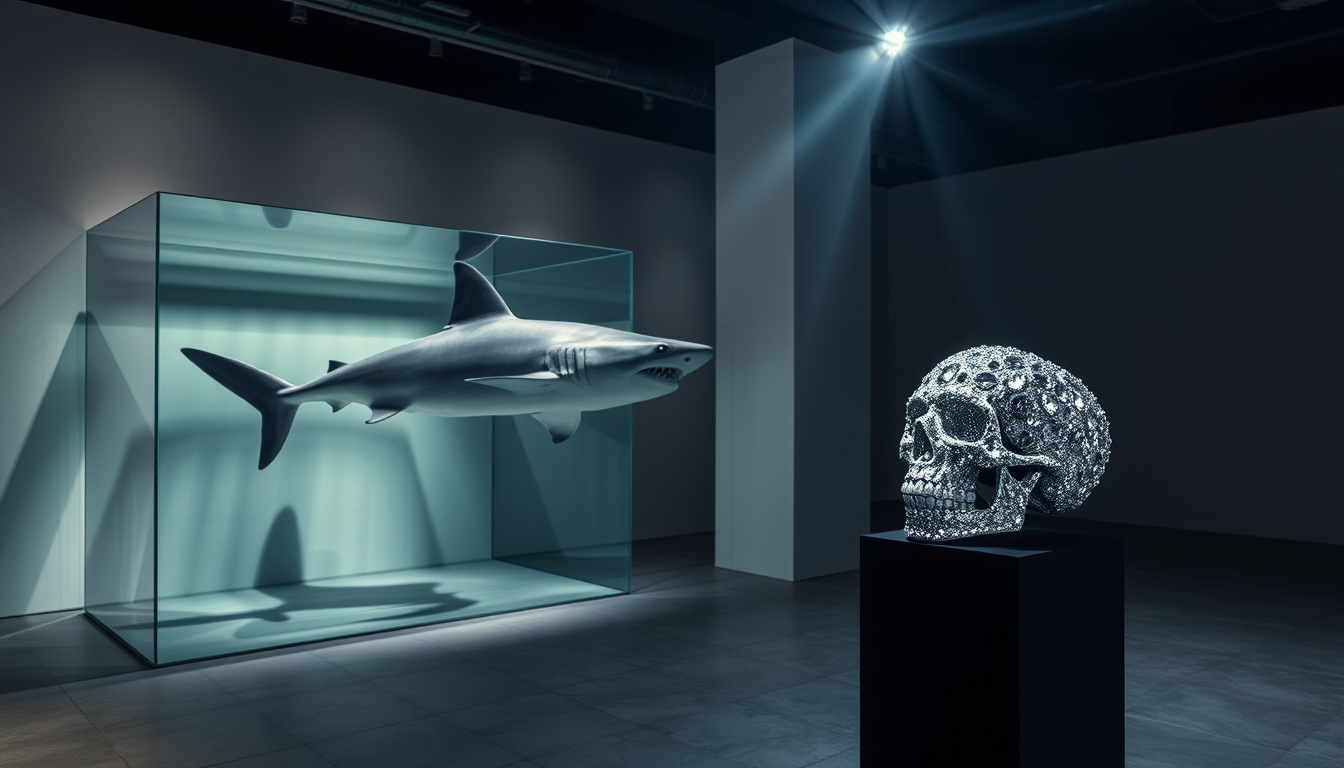
Damien Hirst is the most commercially successful British artist of his generation, a figure who turned dead animals in formaldehyde and mass-produced spot paintings into a global brand. His work confronts mortality, medicine, and desire, and has made him the UK’s richest living artist. This article provides a fact-driven overview of his biography, key artworks, net worth, controversies, and where to buy his work.
What is Damien Hirst’s net worth and how did he become the UK’s richest living artist?
7 June 1965, Bristol, England
Formaldehyde animals, spot paintings, diamond skull
US$384 million (Sunday Times Rich List)
Young British Artists (YBAs)
- Damien Hirst remains the UK’s wealthiest living artist, with a net worth estimated at $384 million in 2020.
- His most famous work, ‘The Physical Impossibility of Death in the Mind of Someone Living’ (a tiger shark in formaldehyde), sold for $12 million in 2004.
- Hirst’s diamond skull ‘For the Love of God’ (2007) was priced at £50 million and is one of the most expensive contemporary artworks ever created.
- The ‘Spot Paintings’ series (1986–2011) includes over 1,400 works, each designated by a pharmaceutical name.
| Fact | Detail |
|---|---|
| Full name | Damien Steven Hirst |
| Education | Goldsmiths, University of London (BA in Fine Art) |
| Breakthrough exhibition | Freeze (1988), curated by Hirst |
| Most expensive work sold at auction | ‘The Physical Impossibility of Death…’ (shark) – $12 million in 2004 |
| Signature style | Death, mortality, science, and religion themes using preservation in formaldehyde |
| Notable collector | Charles Saatchi (early patron) |
Hirst’s wealth is built on a mix of landmark sales and a multi-channel market. According to Wikipedia, the 2020 Sunday Times Rich List estimated his fortune at US$384 million, making him the richest living British artist. However, estimates vary widely: some sources suggested he was worth about $1 billion in 2008, while others cited €700 million in 2010. These discrepancies underscore how difficult it is to pin down the exact net worth of an artist whose wealth is tied to a fluctuating art market.
Hirst generates income from multiple streams: high-value original works, limited edition prints, and more recently, NFTs. In 2008, he bypassed traditional galleries entirely with the auction “Beautiful Inside My Head Forever,” reportedly earning around $200 million. This direct-to-auction strategy was unprecedented and cemented his reputation as a master of the art market.
How does Damien Hirst generate income from prints and NFTs?
Hirst is widely known for editioned works and prints. His spot paintings, produced in serial form, have been circulated through the market in multiple formats, making his work accessible to a broader range of collectors. While a complete catalogue of print editions is not publicly available, sources confirm that his practice is heavily associated with multiplicity and market-friendly formats. In 2021, Hirst launched the NFT project “The Currency,” selling 10,000 unique works. In October 2022, he began burning thousands of original works tied to the project after their NFT sales, with an estimated value of around €10 million, as reported by German Wikipedia. This experiment highlighted the tension between physical art objects and digital ownership.
While Hirst is widely considered the UK’s richest living artist, exact net worth figures are disputed. The 2020 Sunday Times Rich List figure of $384 million may already be outdated, and estimates from different years vary dramatically.
Why is Damien Hirst’s shark (The Physical Impossibility of Death in the Mind of Someone Living) so famous?
The shark is arguably the single most iconic artwork of the Young British Artists movement. Created in 1991, the piece consists of a tiger shark preserved in formaldehyde inside a glass display case. It is not merely a specimen; it is a confrontation with mortality. Hirst has said the work is “about the fear of death,” according to The Art Story. The title itself, “The Physical Impossibility of Death in the Mind of Someone Living,” captures this paradox: we know we will die, but we cannot truly imagine it.
How was the shark preserved and what happened to it?
The tiger shark was caught off the coast of Australia and shipped to London. It was then injected with formaldehyde and placed in a tank of the same solution. Over time, the original shark began to decompose because the formaldehyde was not properly infused. Hirst later had the shark replaced with a new specimen in 2006. The original 1991 shark is now owned by billionaire Steven A. Cohen and was on display at the Metropolitan Museum of Art. A later version is housed in a Japanese museum.
How much did the shark sell for?
The shark initially sold to Charles Saatchi for £50,000 in 1992. In 2004, it was sold to Steven A. Cohen, a hedge fund manager, for $12 million. This sale was a landmark moment for contemporary art, proving that conceptual works could command prices previously reserved for Old Masters.
The shark is not just a preserved animal; it is a philosophical statement. It forces the viewer to look at death directly, yet the animal is suspended in a state that mimics life. This tension between life and death is central to Hirst’s entire body of work.
What are Damien Hirst’s most iconic artworks – skull, cow, animals, and dot paintings?
Beyond the shark, Hirst has produced a series of works that have become cultural landmarks. Each piece or series explores a different facet of his core themes: mortality, beauty, religion, and the aesthetics of science and medicine.
What is special about Damien Hirst’s diamond skull ‘For the Love of God’?
Unveiled in 2007, ‘For the Love of God’ is a platinum cast of an 18th-century human skull, covered with 8,601 diamonds. The only original part of the underlying skull is the teeth. It was priced at £50 million, making it one of the most expensive contemporary artworks ever created. The actual sale price has never been officially disclosed, but it is widely believed to have been sold to a consortium of investors. The skull functions as a modern memento mori – a reminder of death – but its extravagant materials also comment on wealth and excess.
What do the spot paintings represent?
Hirst’s spot paintings are grids of colored dots on a white background, each titled after a pharmaceutical chemical. Hirst described them as a way of “pinning down the joy of color.” They reference the aesthetics of science, pharmaceuticals, and order. Over 1,400 spot paintings exist, created between 1986 and 2011. Importantly, most of these were executed by assistants under Hirst’s direction, a fact that has sparked debate about authorship and authenticity in his work.
What animals has Damien Hirst preserved and why?
Hirst has preserved a variety of animals in formaldehyde, including a shark, sheep, pig, and cow. One notable example is ‘Away from the Flock’, a lamb in formaldehyde, and ‘Mother and Child Divided’, a cow and calf bisected and displayed in separate tanks. These works are not about taxidermy; they are about the physical reality of death. The animals are presented as medical specimens, stripped of sentimentality. According to Britannica, Hirst’s use of dead animals in formaldehyde is one of the defining features of his early career.
Where can I buy Damien Hirst artwork and limited edition prints?
Hirst’s work is available through multiple channels, from major galleries to online marketplaces. For buyers seeking authenticity and provenance, the primary sources are the galleries that represent him. However, the market also includes a robust secondary market and official print editions.
Hirst is officially represented by White Cube Gallery, which regularly holds exhibitions of his work. Artsy also lists his works for sale and provides auction results, making it a useful resource for tracking market value. Limited edition prints, particularly of his spot paintings and other popular series, are widely circulated through galleries like Clarendon Fine Art and other authorized dealers. It’s important to verify authenticity through official channels, as the market for reproductions is significant.
In 2021, Hirst launched his NFT project ‘The Currency’, which is available on NFT marketplaces. This digital experiment allows collectors to trade digital versions of his works, though the project has also involved the physical destruction of originals, creating a unique collectible dynamic.
Damien Hirst Career Timeline
- 1965: Born in Bristol, England.
- 1988: Organised the landmark ‘Freeze’ exhibition in London, launching the YBA movement.
- 1991: First solo exhibition ‘In and Out of Love’ at the Woodstock Street Gallery.
- 1992: Featured in the Young British Artists exhibition at the Saatchi Gallery.
- 1997: Shark installation sold to Charles Saatchi for £50,000.
- 2004: Shark sold to Steven A. Cohen for $12 million.
- 2007: ‘For the Love of God’ (diamond skull) unveiled, priced at £50 million.
- 2012: Retrospective at Tate Modern, London.
- 2021: Launched NFT project ‘The Currency’, selling 10,000 unique works.
- 2024: Continues to exhibit globally and produce new series.
What is known for certain, and what remains unclear about Damien Hirst?
| Established Information | Information That Remains Unclear |
|---|---|
| Damien Hirst was born in 1965 and studied at Goldsmiths. | Exact net worth fluctuates with art market; 2020 figure may be outdated. |
| He is the UK’s wealthiest living artist as of the 2020 Sunday Times Rich List. | The diamond skull’s actual sale price is undisclosed; it was reportedly sold to a consortium, not a single buyer. |
| The shark artwork is titled ‘The Physical Impossibility of Death in the Mind of Someone Living’. | The number of assistant‑produced works versus Hirst’s own hand is debated among critics. |
| Hirst’s spot paintings are titled after pharmaceutical names. | The full catalogue of his print editions is not publicly documented. |
How should we understand Damien Hirst’s impact on contemporary art?
Damien Hirst emerged in the late 1980s as a leading figure of the Young British Artists, challenging traditional boundaries between art, science, and commerce. His work often confronts mortality directly, using taxidermy and preserved specimens. Hirst’s commercial success and media savvy have made him a polarising figure. Critics argue his work is shock‑driven and over‑produced by assistants, while supporters see a profound meditation on death. The diamond skull exemplifies this tension – a memento mori that itself became a symbol of excess. His later foray into NFTs shows continued adaptation to market trends. Hirst is important because he fused shock, commerce, and conceptual art into a highly recognizable brand.
What have critics and sources said about Damien Hirst?
“I can’t understand why people are frightened of new ideas. I’m frightened of the old ones.”
Damien Hirst, interview with The Guardian (2000)
“The Physical Impossibility of Death in the Mind of Someone Living is a work about the fear of death.”
Damien Hirst, quoted in The Art Story
He is reportedly the United Kingdom’s richest living artist, with his wealth estimated at US$384 million.
Wikipedia, citing 2020 Sunday Times Rich List
What is the key takeaway about Damien Hirst?
Damien Hirst is a defining figure of the Young British Artists movement, known for provocative works such as the formaldehyde shark and diamond skull. His career illustrates how contemporary art can function as both cultural commentary and financial asset. While his exact wealth fluctuates, he remains the UK’s richest living artist, with a market that spans original works, prints, and NFTs. For those interested in collecting, the primary channels are White Cube Gallery and Artsy, though authenticity should always be verified through official sources. You may also find interest in the work of Martin Parr – British Documentary Photographer Dies at 73 for another perspective on British cultural icons, or the Art Attack – Complete Guide to the Iconic Children’s Art Show for a contrasting look at creativity in popular culture.
Frequently Asked Questions
What is Damien Hirst’s most expensive artwork?
The diamond skull ‘For the Love of God’ was priced at £50 million. The highest confirmed auction price is $12 million for the shark.
Why does Damien Hirst use formaldehyde?
Hirst uses formaldehyde to preserve animals as a way to explore mortality, making death both present and suspended in time.
Are Damien Hirst’s spot paintings made by him?
Most spot paintings were executed by assistants under Hirst’s direction. Hirst conceptualizes the works, but the repetitive dots are typically painted by studio assistants.
Where is Damien Hirst’s shark now?
The original 1991 shark is owned by billionaire Steven A. Cohen and was on display at the Metropolitan Museum of Art. A later version is in a Japanese museum.
Does Damien Hirst still create new works?
Yes, Hirst remains active, with recent series like ‘The Currency’ (NFTs) and ‘Cherry Blossoms’ paintings.
How did Damien Hirst become famous?
He became famous after organizing the ‘Freeze’ exhibition in 1988 and creating his first formaldehyde shark in 1991, which was quickly bought by Charles Saatchi.
What is the meaning behind Damien Hirst’s animals?
His preserved animals are about the physical reality of death and the viewer’s inability to fully comprehend it, presented as clinical specimens.
Is Damien Hirst considered controversial?
Yes, critics have questioned the originality, ethics, and shock value of his work, as well as the use of assistants to produce his paintings.

Oliver Arthur Morgan Harrison is a staff writer for StoryShift.uk, covering UK news, culture, politics and technology. He works under Editor-in-Chief Maarika Tamm and UK Managing Editor Oliver Grant, following the newsroom standards for sourcing, verification and fact-checking set out in our editorial policies.