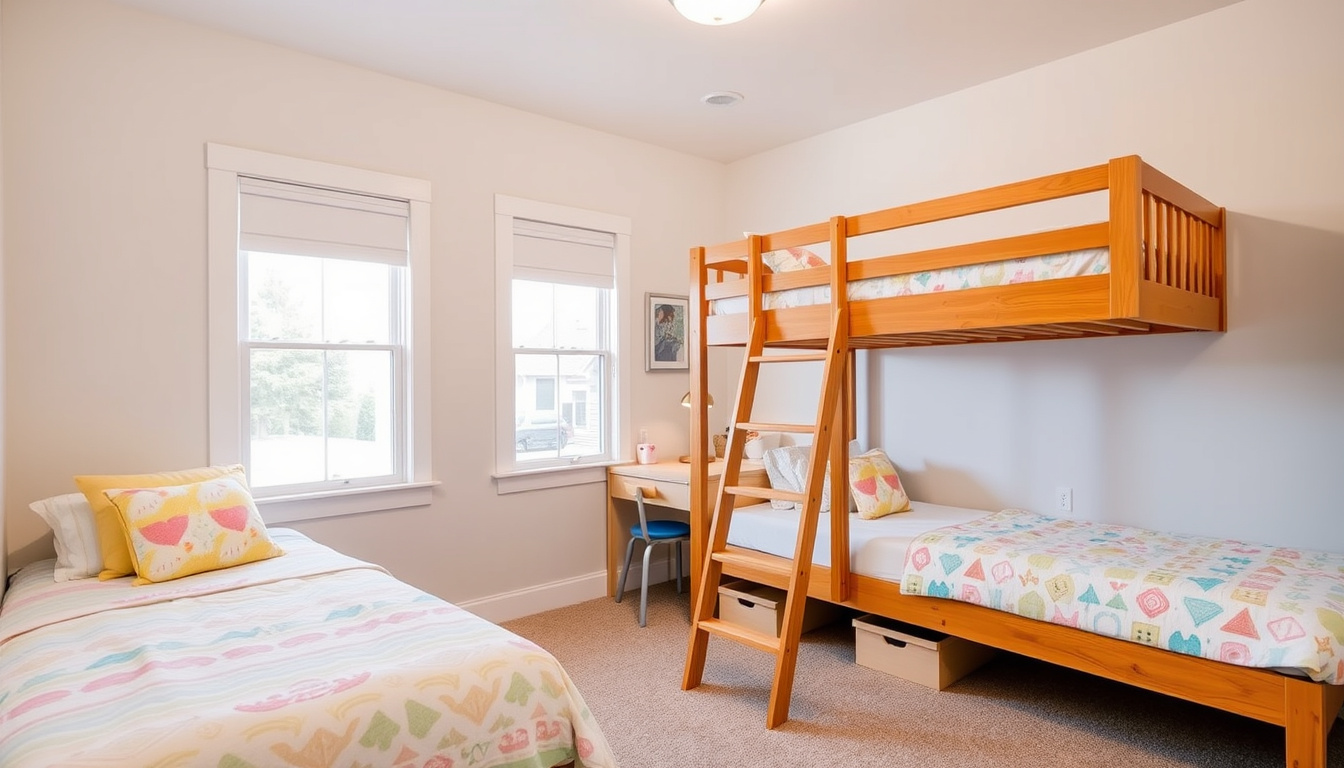
Bunk beds remain one of the most practical ways to add sleeping space without expanding a room’s footprint. The 2025 market now spans kids’ frames, heavy-duty adult models, triple sleepers, and loft-style designs, so the right starting point is matching the bed to the sleeper and the space.
Families usually need sturdy wood or steel frames with full guardrails, a fixed ladder, and a clearly stated weight limit. Adults and guest rooms call for adult-rated models with higher per-bunk capacity and enough ceiling clearance for safe movement on the upper level.
The main categories, safety requirements, and sizing rules are laid out below, along with the details that separate a sound purchase from a risky one.
What Are the Best Bunk Beds for Kids?
Quick comparison of bunk bed types
| Type | Description | Best for | Key feature |
|---|---|---|---|
| Kids’ bunk beds | Designed for children, lower weight capacity, fun designs, safety rails required | Children aged 6+ | Guardrails at least 5 inches above the mattress |
| Adult bunk beds | Heavy-duty frame, higher weight capacity, often full or double size | Teens, adults, guest rooms | Per-bunk limits around 300–400 lb or more |
| Bunk beds with storage | Built-in drawers, shelves, and trundle beds to maximise space | Small bedrooms, dorm rooms | Up to 4 drawers or integrated shelving |
| Fabric or metal bunk beds | Lightweight metal frames or fabric-covered designs such as tent styles | Toddlers, temporary rooms | Easy assembly, low profile |
Several patterns separate well-designed bunk beds from problem purchases.
- Bunk beds maximise floor space, but safety and weight limits are often overlooked by first-time buyers.
- Kids’ bunk beds dominate the market, while adult-rated frames are a growing segment for small apartments.
- Storage integration is the most requested feature in bunk bed searches.
- Many product pages omit safety certifications and clear weight specifications, putting the burden on buyers to verify.
- Fabric tent-style bunk beds are trending for younger children, but their long-term durability is not well documented.
- Safety standards for guardrails, mattress fit, and gap limits exist in most countries yet vary by region.
| Fact | Detail |
|---|---|
| Standard UK single bunk mattress size | 90 × 190 cm |
| Minimum guardrail height required (UK/EU) | 16 cm |
| Typical maximum capacity, kids’ bunk beds | 50–100 kg per bunk |
| Some adult-rated bunk capacities | Up to 200–250 kg per bunk |
| Storage-equipped bunk beds | Can reduce additional furniture needs by about 30% |
| Most searched bunk bed brand | IKEA |
The safest kids’ frames are defined by a few non-negotiable details. Children under six should not sleep on the top bunk, a rule repeated in MomLovesBest’s bunk bed guide and Health Canada’s safe-sleep guidance. Guardrails must run along all sides of the upper bed, and the mattress should sit low enough that at least about five inches of rail remains above the mattress surface, per Health Canada. A fixed, stable ladder with evenly spaced rungs also matters; Coleman Furniture’s buying guide flags loose or easily shifted ladders as a common weakness. Many kid-focused top bunks carry weight limits in the 150–250 lb range.
Material choice affects how the bed performs over time. Wood frames tend to support heavier sleepers and feel more stable, which is why HomeToSight recommends solid wood or quality engineered wood for long-term use. Metal frames are lighter and usually cheaper, but budget versions may carry lower weight limits, as Mattress Stores Los Angeles explains. Fabric tent-style designs appeal to younger children, yet they typically trade off durability and long-term load capacity.
The age rule holds across all materials. The NHS advises that children under six should not use the top bunk, matching guidance from Health Canada and the American Academy of Pediatrics. For parents moving a child into a shared bedroom, the shift often involves new routines alongside furniture, and family resources such as Potty Train Guide UK cover the everyday side of that transition.
Are There Bunk Beds Designed for Adults?
Yes. Adult-rated bunk beds use heavier frames, stronger joints, and larger fasteners than typical children’s models. Weight limits show the difference clearly: many kid-focused top bunks sit in the 150–250 lb range, while heavy-duty wood or adult-rated frames often support 300–400 lb per bunk or more depending on construction. Mattress Miracle’s bunk and loft guide covers those ratings and adds that ceiling height becomes a larger concern when adults use the upper bunk.
What weight limit should an adult bunk bed have?
Look for a per-bunk limit of at least about 300 lb for regular adult use. Models marketed for adults also tend to include wider ladder steps, thicker frame hardware, and stronger mattress support. Heavier users should compare the stated limit against their own needs and keep a reasonable safety margin.
What size mattress fits an adult bunk bed?
Twin-over-full configurations are the most common adult-friendly layout, giving the lower sleeper more room. A full or double mattress on the bottom measures roughly 135 × 190 cm in UK sizing, while the top bunk typically takes a single mattress. A mattress that is too thick can reduce guardrail protection, so the manufacturer’s maximum thickness is the figure to follow.
Can adults use a bunk bed for guests?
Yes. Adult-rated bunks are frequently used in guest rooms and shared apartments. The lower bunk suits most guests, while the top bunk works when the weight rating and ceiling clearance are adequate. For an older guest, a twin-over-full frame is usually the more comfortable layout.
Loft and upper-bunk setups need enough space above the mattress. One guide cites about 35 inches of clearance between the mattress top and the ceiling as a helpful benchmark for sitting up and moving comfortably.
What Bunk Beds Have Built-in Storage?
Storage is the most requested feature in bunk bed searches, and modern frames include everything from simple shelves to full staircases with drawers. Built-in drawers work well for clothes and bedding, while the open space under a loft or higher bunk frame creates room for bins, a desk, or a play corner. IKEA’s MYDAL and VITVAL frames both leave usable space beneath the lower bunk.
What types of storage are available?
Common options include under-bed drawers, side shelves or cubbies for books and lamps, stairs with built-in storage, and trundle beds that pull out for extra sleeping space. Stairs are handy for adults and shared rooms, but they increase the overall footprint.
Do storage bunk beds come in different sizes?
Storage versions are available in twin-over-twin, twin-over-full, and loft configurations. Loft beds with a desk underneath are a frequent choice for studios and small bedrooms, while drawer-equipped twin-over-twin frames suit children’s rooms.
Are there bunk beds with drawers or shelves?
Yes. Many frames include side cubbies for books, glasses, and charging devices, and drawer units can be built into the base or the stairs. The amount of storage varies by model, so it is worth checking the product specification rather than assuming.
Lower-profile mattresses are usually required on the top bunk. IKEA’s TUFFING frame, for example, allows a maximum mattress thickness of 5 1/8 inches, while the MYDAL accepts up to 8 1/4 inches. A mattress that is too thick leaves less guardrail protection.
What Is a Double Bunk Bed and How Does It Differ?
A double bunk bed generally means a frame with a wider lower mattress, most often a twin-over-full layout: a single bed on top and a double or full bed below. The label can also describe any bunk that sleeps two people. The more useful distinction for buyers is between standard bunks, twin-over-full frames, triple bunks, and loft beds.
Double bunk bed vs. triple bunk bed
A standard double bunk sleeps two people, while a triple bunk fits three sleepers in vertical space. Triple designs are more complex, bulkier, and less forgiving when it comes to ceiling height and assembly, as Roomix’s guide explains. They also sit at the upper end of the price range because of the extra materials and stronger joints required.
Loft beds and double loft beds
Loft beds lift a single sleeping surface and leave the floor below open for a desk, storage, or seating. They suit studios and small bedrooms, and Homes to Love highlights their space-saving appeal. Double loft beds combine a raised bed with usable space underneath, but they need stronger construction and careful planning for ladder access.
Can a double bunk bed be separated into two single beds?
Not every model can be split into two separate beds. Conversion depends on the frame design, so buyers should confirm it in the product listing or manual before assuming the bed will come apart. When conversion is supported, it usually adds flexibility as children grow.
Assembly is more involved than a standard bed, especially for bunk, loft, and triple frames. All bolts, ladder connections, and guardrail joints should be tightened and re-checked after a few days of use. Wall anchoring is recommended for some tall loft-style models, per Gavigan’s Home Furnishings, and the manufacturer’s manual should always be followed. IKEA publishes official bunk bed manuals online for reference.
Weight limits vary widely by brand and model. In some inexpensive imported beds, the advertised capacity may not be tested to the stated level, so the manufacturer’s rating and assembly instructions remain the reference point.
How Have Bunk Beds Changed Over Time?
Bunk beds have moved from ship decks and barracks into family homes, and each era added something to the design.
- — Early ship bunks: stacked sleeping spaces on naval vessels.
- — Bunk beds become common in military barracks and dormitories.
- — Children’s bunk beds are introduced in homes, often in metal frames.
- — Wooden bunk beds gain popularity; safety standards such as ASTM F1427 begin to appear in the US and UK.
- — Innovation expands: loft beds, storage integration, triple sleepers, and themed designs.
- — Adult bunk beds rise for urban living, fabric tent-style beds appear for toddlers, and smart storage solutions become common.
What Is Confirmed About Bunk Beds and What Should You Verify?
Some aspects of bunk bed safety are well established, while others depend on the specific product.
| Established | Worth verifying |
|---|---|
| Bunk beds are designed to maximise vertical space. | The long-term durability of fabric bunk beds is not well documented. |
| Safety standards exist in most countries, covering guardrails, mattress fit, and gap limits. | Weight limits on some inexpensive imported beds may not be tested to advertised levels. |
| Weight limits vary widely by brand and model. | Assembly instructions on some models may be incomplete, so the manufacturer’s manual remains the primary reference. |
Buyers checking national requirements can consult the UK government’s product safety guidance on beds and bunk beds.
How to Choose the Right Bunk Bed
Start by identifying who will use the bed and their weight. Children under six should not use the top bunk, which makes a low-profile twin-over-twin the usual starting point for young families. Teens and adults need higher per-bunk weight ratings, wider ladder steps, and stronger frame hardware.
Room dimensions come next. The frame should fit the floor area comfortably, and the ceiling must leave enough clearance above the top mattress — around 35 inches between the mattress surface and the ceiling is a practical benchmark. Material choice follows the same logic: wood for durability and higher loads, metal for lighter and usually cheaper frames, and fabric for a playful, low-weight look.
Storage needs, assembly complexity, and budget also shape the decision. Under-bed drawers, shelving, and stairs with storage all increase usefulness but raise the price. Basic metal frames are the least expensive option, while solid wood and higher load ratings push costs upward. Regional pricing varies as well: IKEA lists the VITVAL at $399, while a Turkish market listing prices the SVÄRTA, a 90 × 200 cm bunk bed with a 100 kg maximum load, at ₺17,999. Checking reviews and confirming certifications such as BS EN 747 before purchase is the final step.
Where Do Bunk Bed Safety Standards Come From?
Bunk bed safety is set at national and international levels. In the UK and EU, BS EN 747-1:2021 defines the safety requirements, including minimum guardrail heights and maximum gap sizes to prevent entrapment. In the United States, ASTM F1427 provides the equivalent consumer safety specification.
“All bunk beds sold in the EU/UK must comply with BS EN 747, which specifies minimum guardrail heights and maximum gaps to prevent entrapment.”
British Standards Institution
“The American Academy of Pediatrics recommends that children under 6 years of age should not use the top bunk.”
American Academy of Pediatrics
Product certifications are not always visible in online listings, so confirming that a frame meets the relevant standard remains part of the buyer’s homework.
Which Bunk Bed Should You Choose?
The right bunk bed depends on who sleeps in it and how the room is used. For young children, a low-profile twin-over-twin with strong guardrails and the 6+ top-bunk rule is the safest place to start. Teens and adults should prioritise frames with higher per-bunk weight limits and wider ladder steps. Small rooms and apartments benefit from storage-equipped or loft designs. Whatever the configuration, checking the weight rating, mattress dimensions, and ceiling clearance before assembly prevents most of the problems that surface later. A bunk bed often becomes the social centre of a shared bedroom, where siblings develop bedtime rituals and games that begin with questions like Would You Rather Questions.
Frequently Asked Questions About Bunk Beds
How much does a bunk bed cost?
Prices vary widely. Basic metal bunk beds start at around £100, wooden models generally range from £200 to £500, and high-end designer bunk beds can exceed £1,000. Regional pricing also varies.
What size mattress fits a bunk bed?
Most single bunk beds accept a standard single mattress (90 × 190 cm). Double bunk beds require a double mattress (135 × 190 cm). Some international models use 90 × 200 cm mattresses, so check the product specification.
Are bunk beds safe?
Yes, when assembled correctly and used according to manufacturer guidelines. Key measures include secure guardrails, a stable ladder, gaps between mattress and frame no larger than 7.5 cm, and no children under 6 on the top bunk.
How do I assemble a bunk bed?
Most bunk beds require two people and basic tools such as an Allen key and screwdriver. Tighten all bolts and re-check connections after a few days. Follow the included manual and anchor the frame to the wall if recommended.
What is the difference between a bunk bed and a loft bed?
A bunk bed has at least two beds stacked vertically. A loft bed has one bed on top with open space underneath, usually for a desk, seating, or storage.
Can I buy a bunk bed for a small room?
Yes. Many bunk beds have a compact footprint. Measure the room height (at least 2.4 m for a top bunk) and the floor space (around 2 m × 1.5 m for a single bunk bed) before purchasing.
What is the weight limit for a bunk bed?
Limits vary by model. Many kid-focused top bunks are rated around 150–250 lb, while heavy-duty wood or adult-rated frames often support 300–400 lb per bunk or more. Check the manufacturer’s stated limit.

Oliver Arthur Morgan Harrison is a staff writer for StoryShift.uk, covering UK news, culture, politics and technology. He works under Editor-in-Chief Maarika Tamm and UK Managing Editor Oliver Grant, following the newsroom standards for sourcing, verification and fact-checking set out in our editorial policies.