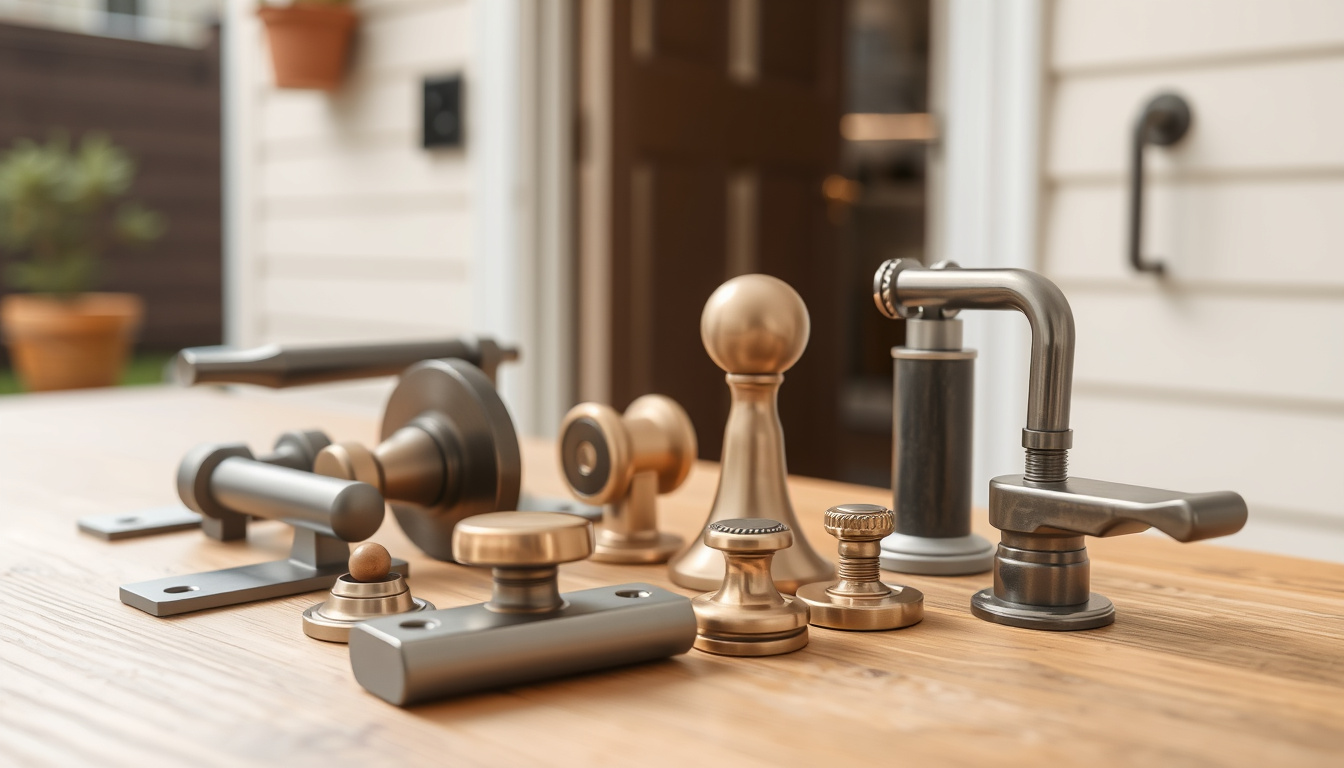
A good UK door-handle purchase starts with door function, compatibility measurements and security requirements, rather than appearance alone. Internal latch handles are usually straightforward, while bathrooms, fire doors, entrance doors and uPVC or composite doors need specific hardware.
The choice on the market is wide: traditional lever-on-backplate fittings, minimalist lever-on-rose designs, pull handles for entrance doors and compact door knobs. The deciding factors are practical. How the handle fixes to the door, what it operates, and whether the spindle and screw positions line up with the existing latch or lock all matter more than the finish.
The practical guidance published by ASSA ABLOY, Wickes and Door Furniture Direct, among others, covers most of what buyers need to check. The main types, the measurements to record and the security points to consider are the core of any purchase decision.
What are the best external door handles for wooden doors?
Handles with locks for bathrooms, bedrooms and external doors.
Backplate and spindle sizes to ensure a correct fit for UK doors.
Matte black, satin brass, chrome and other popular finishes.
Step-by-step guidance for swapping an old handle.
Five points matter most when choosing a handle, whatever the door type:
- Around 80% of door handle returns are linked to incorrect spindle length or backplate size, so measuring first is essential.
- Modern handles with locks are increasingly used in bathrooms, home offices and other rooms that need privacy.
- External handles on wooden doors should be stainless steel or brass to resist corrosion.
- Screwfix offers affordable options, while premium brands such as Carlisle Brass add durability and finish choice.
- Wardrobe handles are a separate category, with typical lengths from 96mm to 200mm.
Quick facts: door handles at a glance
| Measurement or feature | Typical value |
|---|---|
| Common backplate sizes | 50mm, 57mm, 76mm, 96mm, 128mm |
| Standard spindle size | 8mm square (most UK locksets) |
| Most popular finishes 2024–2025 | Matte black, satin brass, brushed nickel, polished chrome |
| External handle material | Stainless steel grade 304, brass or bronze |
| Average cost range | £5–£50 (basic) to £100+ (premium designer) |
| Typical warranty | 10–25 years for quality brands such as Carlisle Brass and ERA |
Internal and external handles face very different conditions. Internal handles operate a latch in a dry environment; external handles are exposed to rain, UV light and temperature swings. Stainless steel in grade 304 or 316 and high-grade brass are the recommended materials for wooden external doors. Plated or powder-coated finishes can chip over time, which is why solid brass is often preferred where longevity matters.
Lockable external handles are not always necessary. Many entrance doors use a simple pull handle, with security provided by a separate deadbolt or mortice lock. Where an external handle does include a lock, it must match the lock case and the cylinder cut-out. On uPVC and composite doors, the handle must also align with the multipoint lock’s PZ centres, fixing centres and backplate length.
The main types for external wooden doors are lever handles on a backplate or rose, and pull handles. Lever-on-backplate designs offer a traditional appearance and can conceal marks from older fittings, as Door Furniture Direct notes. Door knobs remain an option, but they need a twisting grip and are generally less accessible than levers. For front doors, matching the handle to the installed locking mechanism is the priority, which is the approach behind ERA’s external handle buying guide.
Which modern door handles with locks offer the best security?
Modern handles with locking functions fall into a few distinct groups. Lock handles pair with a mortice sashlock or similar lock and usually include a keyhole cut-out in the backplate. Bathroom handles work with a bathroom lock and thumbturn. Lever-on-rose handles keep a cleaner look but may need a separate lock, latch or bathroom turn.
What types of locks are integrated into modern door handles?
Tubular latch handles operate without locking and suit rooms where privacy is not required. Lock handles add a keyed function, usually through a mortice sashlock. Bathroom handles use a privacy lock with a thumbturn, and the set should include an external emergency release or coin-operated slot. On uPVC and composite entrance doors, the handle integrates with a multipoint lock and must match its dimensions exactly, including PZ centres, fixing centres and backplate length, as set out in Door Furniture Direct’s uPVC and composite handle range.
How to choose a door handle with a lock for a bathroom or bedroom?
For a bathroom, the key requirement is a privacy lock with a thumbturn and an external emergency release. Without that release, someone locked inside cannot be assisted from outside. For bedrooms and home offices, a key-lock handle offers more privacy than a simple latch, while a privacy turn may be enough for a study. The spindle must align with the lock cam, so checking the existing latch or lock before ordering is essential.
Are modern door handles with locks suitable for external use?
Some are, but only when matched to the installed lock. The handle’s cylinder cut-out, PZ measurement and fixing pattern must all align. For high-risk external doors, security hardware should be tested to BS EN 1906, with corrosion resistance assessed under BS EN 1670. Mila’s SupaSecure range, for example, cites BS EN 1906 testing, Grade 5 corrosion resistance and a 100 kg lever-pull test in its SupaSecure handle brochure. Fire doors are a separate case: their complete hardware installation, including handles, should be fire-rated and independently tested to relevant British or European standards, as ASSA ABLOY explains.
A handle is only one part of a door-security system. The cylinder, mortice lock, multipoint mechanism, door, frame and fixing method matter equally. On external doors, match the handle to the installed lock and check that the cylinder cut-out, PZ measurement and fixing pattern align. Internal privacy locks with thumb-turns are not suitable for external doors. Bathroom sets should always include an external emergency release.
How do I install a door handle? Step-by-step guide for different types
Replacing a door handle is a practical DIY job when the new hardware matches what is already fitted. Most lever sets are reversible, but some specialist, security and pull handles are handed, so the orientation of the replacement should be confirmed before starting. For a like-for-like swap, the sequence below applies; for a new installation, the door needs extra preparation.
How to replace a door handle with a lock?
Removing the old handle and fitting the new one follows a clear order. Wickes, for example, groups its door handles by room and function in its door-handle range, which makes identifying the right type easier.
Removing the existing handle
- Secure the door open and support the existing handle.
- Remove the fixing screws and separate the inside and outside handles.
- Remove the old spindle and latch if they are being replaced.
Fitting the replacement
- Confirm that the new latch backset and faceplate fit the door edge.
- For a new installation, bore the spindle hole squarely through the door and mortice the latch faceplate flush.
- Insert the spindle through the latch follower.
- Fit both handle halves, aligning the fixing screws and avoiding over-tightening.
- Fit or adjust the strike plate with the door closed so the latch enters cleanly.
- Test lever movement, latch engagement, key operation and emergency release several times.
What tools are needed to install a door handle?
A like-for-like replacement may need no more than a screwdriver to undo and refit the fixing screws. A new installation is more involved: the door must be bored for the spindle and the latch faceplate morticed flush into the door edge. For visual, step-by-step guidance, Checkatrade’s guide to fitting a door handle follows a similar sequence.
What is the standard spindle size for UK door handles?
Most UK residential handles use an 8mm square spindle. The length must suit the door and lock, so it is worth holding on to the old spindle when ordering a replacement. A spindle that is too short will not engage the latch follower; one that is too long protrudes and can bind.
How to measure backplate size for a new handle?
Before ordering, record the door thickness, backset, PZ or centres, fixing centres, spindle length and the dimensions of the existing backplate or rose. The four most useful measurements are door thickness, edge-to-spindle distance, spindle-to-keyhole or turn distance, and the size of the existing rose or backplate, as Doors2Floors’ door-handle guide details. Common internal timber doors are around 35mm thick, while fire doors and external doors are often about 44mm. PZ distance runs from the spindle centre to the keyhole or cylinder centre, with 92mm common on modern uPVC and composite doors and 70mm, 68mm and 72mm variants also available. For a more detailed walkthrough, see How to measure a door handle (with video guide).
Use through-bolts where supplied: they join both handles through the door and generally provide a stronger, longer-lasting fixing than relying only on wood screws. After fitting, test lever movement, latch engagement, key operation and emergency release several times before finishing.
Are Screwfix door handles a good choice? Comparison with other brands
Screwfix is a common first stop for door handles because of its wide availability and competitive pricing. The quality question is less about the retailer than about the specific product: Screwfix sells both budget lines and branded hardware, so the material and warranty should be checked on each item.
| Brand or source | Strengths | Best suited to |
|---|---|---|
| ASSA ABLOY | Strong technical guidance covering handle types, fixing methods, accessibility and fire-door requirements | Buyers prioritising standards, specification and commercial-quality advice |
| Wickes | Broad mainstream range including traditional and modern handles, privacy options and replacement guidance | General DIY and readily available internal-handle purchases |
| Häfele UK | Specialist architectural and furniture-hardware supplier with buying-guide resources | Renovation, trade, cabinetry and specification-led projects |
| Screwfix | Wide range across budget and premium brands, with user reviews for most lines | Quick replacements and cost-conscious buyers |
| Carlisle Brass / Heritage Brass | Premium finishes, solid material choices and long warranties on quality ranges | Higher-quality internal and heritage hardware |
How do Screwfix door handles compare to Heritage Brass or Carlisle Brass?
Screwfix covers the budget-to-mid market, while specialist brands such as Carlisle Brass and Heritage Brass concentrate on premium finishes and durability. A Screwfix handle can be perfectly serviceable, but the base material, coating and warranty determine how long it lasts. Quality brands such as Carlisle Brass and ERA typically carry 10–25 year warranties on their ranges.
What is the price range of Screwfix door handles?
Basic handles generally sit in the £5–£50 range, with premium designer hardware above £100. Screwfix’s pricing starts at the budget end, and its product reviews and ratings help gauge how a specific handle performs before purchase.
Do Screwfix offer modern door handles for wardrobes?
Wardrobe handles are typically shorter and slimmer than door handles, with lengths from 96mm to 200mm and smaller projections. Modern options include bar handles and knobs in matte black, satin brass and chrome. Fixing centres and projection need to suit the wardrobe door, so measuring the existing handle matters here too. Specialist suppliers such as Häfele UK carry dedicated ranges for furniture and joinery.
What finishes and styles are available for modern door handles?
The most popular finishes for 2024 and 2025 are matte black, satin brass, brushed nickel and polished chrome. Modern designs favour clean lines, slim profiles and hidden fixings. The table below compares the main finishes and materials.
| Finish or material | Typical characteristics | Best use |
|---|---|---|
| Polished chrome | Bright, reflective and easy to coordinate with chrome taps and fittings | Contemporary bathrooms and modern interiors |
| Satin chrome | Lower sheen and less visually marked than polished chrome | General-purpose modern interiors |
| Satin nickel | Warm grey appearance, usually softer than chrome | Neutral or transitional décor |
| Brass or satin brass | Warm metallic finish; available in polished, satin or aged versions | Traditional, period and contemporary interiors |
| Matt black | Strong contrast and modern appearance; shows dust more readily | Contemporary, industrial and minimalist schemes |
| Bronze | Darker, warmer and often more traditional | Period, rustic or heritage interiors |
| Stainless steel | Durable option for demanding or external applications; 304 stainless steel used in some security ranges | External, commercial and high-use doors |
| Zinc alloy | Often economical and available in many shapes and finishes | Budget-conscious internal applications |
| Solid brass | Substantial, traditional material that can be polished, lacquered or patinated | Higher-quality internal and heritage hardware |
For a deeper look at how finishes age and how to care for them, the complete guide to door handle finishes covers the practical differences.
Finish durability depends on the base material, coating and cleaning regime. For external or high-use doors, prioritise corrosion resistance and tested performance over matching interior décor alone. Some security ranges, such as Mila’s SupaSecure line, use cast 304 stainless steel for strength and finish longevity. Manufacturer guidance from Carlisle Brass covers installation and finish care.
How have door handle designs evolved from the Victorian era to today?
Door handle design has followed broader design movements closely. Knowing the main eras helps when choosing handles for a period property. The milestones below are commonly cited in door-furniture design overviews from UK hardware suppliers.
- Victorian era (1837–1901): porcelain and brass knobs with ornate backplates.
- Early 20th century: Art Deco geometric handles, bakelite and chrome.
- Post-war period: simple lever handles in aluminium and plastic.
- 1990s–2000s: brushed chrome and stainless steel bar handles.
- 2020s onward: matte black, satin brass, minimalistic designs and smart lock integration.
What are the most common door-handle misconceptions?
Several claims about door handles circulate regularly. Some are accurate in specific situations, while others need qualification. The comparison below separates what is established from what depends on the door, the lock and the product range.
| Established information | Information that remains unclear |
|---|---|
| Backplate sizes, spindle lengths and screw centres vary between doors, so measuring before purchase is essential. | Whether a lever-on-rose handle works with an existing lock depends on the spindle aligning with the lock cam. |
| Many external handles are simple pulls; security can be provided by a separate deadbolt or mortice lock. | Whether an external handle needs to be lockable depends on the door’s location and locking system. |
| Screwfix sells both budget and premium brands; material and warranty determine a handle’s quality. | Whether a specific Screwfix handle is lower quality than a premium branded model depends on the range chosen. |
Why have door handles become a design and security consideration?
External handles face weather that internal hardware never encounters. Rain, UV light and temperature changes degrade cheap coatings, so stainless steel in grade 304 or 316 and high-grade brass are the recommended choices for wooden external doors. Powder-coated or plated finishes can chip over time, while solid brass tends to hold up better over the long term.
The look of door hardware has shifted as well. Matte black, satin brass and brushed nickel have overtaken polished chrome as the most common contemporary finishes. Handles with clean lines, slim profiles and hidden fixings suit modern interiors and are now widely available across standard ranges.
Security ratings matter because handles with locks are part of a larger system. Internal privacy locks with thumb-turns are not suitable for external doors. For external use, look for hardware tested to BS EN 1906, ideally a higher grade, and make sure any handle with an integrated key lock matches the lock case.
Where can you find reliable door-handle guidance?
Most reliable guidance comes from manufacturers and standards bodies. The British Standards Institute publishes BS EN 1906: Door Handles Standard (BSI Group), the classification for door handles. ERA publishes product testing information for external handles, Carlisle Brass provides installation and finish-care instructions, and the British Board of Agrément certifies security products.
“The complete hardware installation, including handles, should be fire-rated and independently tested to relevant British or European standards.”
ASSA ABLOY – How to choose the right door handles
“On high-risk external doors, specialist guidance recommends pairing an appropriately rated security handle with a suitable cylinder; the handle rating should not be considered in isolation.”
“Bathroom privacy hardware should always include an external emergency release.”
Door Furniture Direct – Door Handles
What comes next after choosing a door handle?
The next step is to match the handle to the door and its lock. Measure the backplate and spindle length, decide on the lock type based on the room or entrance, then choose a finish that fits the interior. Ordering a sample before buying in quantity can confirm the colour and feel. If the fitting is not straightforward, follow the manufacturer’s installation guide or call in a professional.
Frequently asked questions about door handles
How do I know what size door handle to buy?
Measure the fixing centres, the backplate dimensions and the spindle length. Most UK handles use an 8mm square spindle, with common centres of 57mm or 76mm.
Can I use internal door handles on an external door?
Internal handles are not weather resistant and may corrode quickly on an external door. Use handles rated for external use, ideally in stainless steel, brass or bronze.
What does ‘spring loaded’ mean on a door handle?
A spring-loaded handle automatically returns to the horizontal position. It is useful on latch doors because it prevents the handle from sagging over time.
Are modern door handles compatible with old mortice locks?
Often yes, if the spindle size matches, typically 8mm. The backplate size and screw centres must also align with the existing holes.
What is the difference between a door knob and a lever handle?
A knob requires turning to operate the latch, while a lever is pushed down. Levers are easier to use and more common in accessible and modern designs.
Are door handles universal?
No. Backplate sizes, spindle lengths and screw centres vary between doors. Always measure before buying.
Are external door handles waterproof?
External handles are not all equally weatherproof. Stainless steel, brass and bronze resist moisture well, while plated or powder-coated finishes can chip and corrode over time.

Oliver Arthur Morgan Harrison is a staff writer for StoryShift.uk, covering UK news, culture, politics and technology. He works under Editor-in-Chief Maarika Tamm and UK Managing Editor Oliver Grant, following the newsroom standards for sourcing, verification and fact-checking set out in our editorial policies.