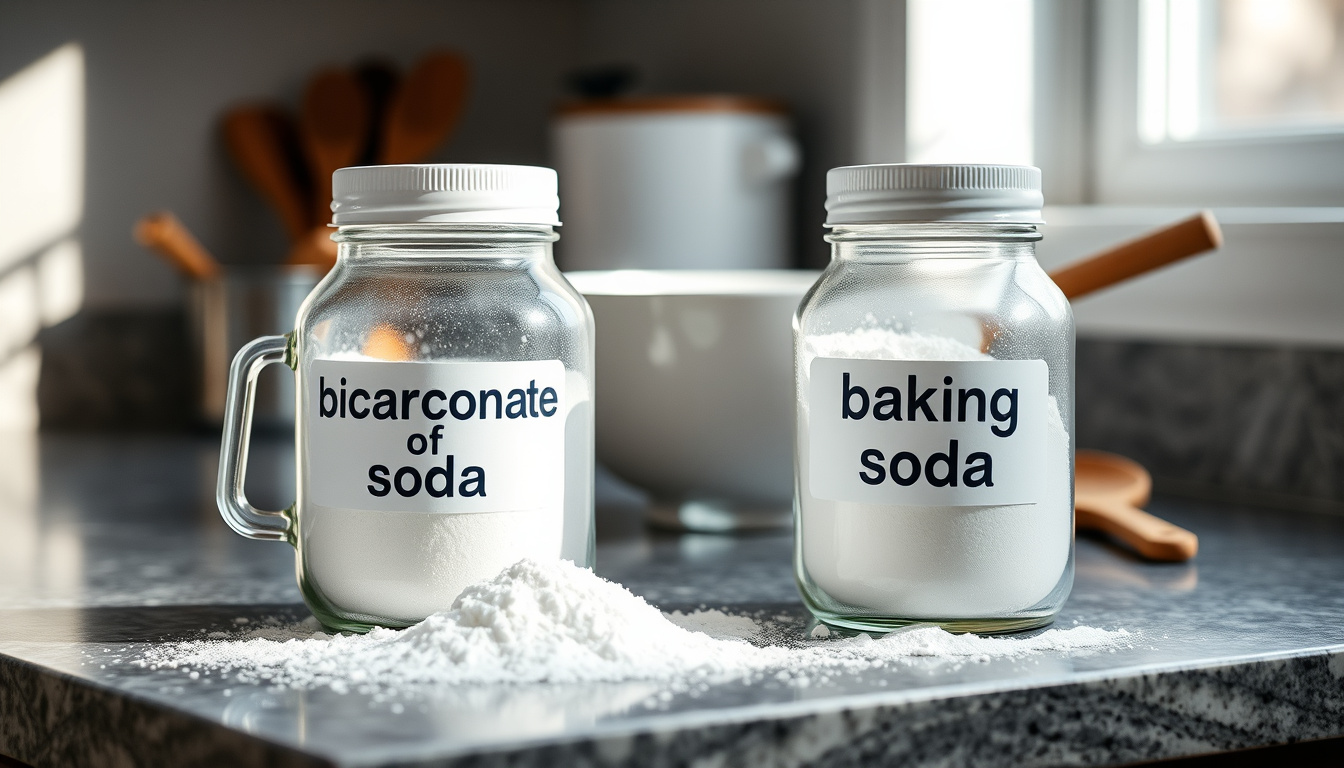
Walking down a supermarket aisle, you might spot boxes labelled “bicarbonate of soda” in one country and “baking soda” in another. This article settles the question once and for all: they are the exact same substance. We also explain how baking powder and soda crystals differ, and what each is actually used for.
Many household cupboards contain at least one of these white powders. Yet confusion about their identities persists. Understanding what each product is, how it works chemically, and where it can—or cannot—be used safely matters for both cooking and cleaning.
Below we break down the key comparisons, provide a quick-reference table, and address common questions about skin, teeth, and edibility. All facts are drawn from publicly available regulatory and scientific sources.
Is baking soda the same as bicarbonate of soda?
Quick answers
- Yes, bicarbonate of soda and baking soda are exactly the same chemical compound: sodium bicarbonate.
- Baking powder is a different product – it contains sodium bicarbonate plus an acid (cream of tartar) and a starch.
- Common uses: baking (as leavening), cleaning (deodorizer, scrub), personal care (exfoliant, teeth whitener), and as an antacid.
- Soda crystals (washing soda) are sodium carbonate – a stronger alkali, not interchangeable with bicarbonate of soda.
Key insights
- Bicarbonate of soda and baking soda are chemically identical – both are pure sodium bicarbonate (NaHCO₃).
- The name difference is purely regional: “bicarbonate of soda” is common in the UK, Australia, and New Zealand; “baking soda” is used in the US.
- Baking powder is a pre-mixed leavening agent that already contains an acid; it should not be substituted 1:1 for baking soda without recipe adjustment.
- Bicarbonate of soda reacts with acids (vinegar, lemon juice, buttermilk) to produce carbon dioxide, causing dough to rise or cleaning fizz.
- Soda crystals (washing soda) are chemically distinct (sodium carbonate) and are much more alkaline; they can cause skin irritation and should not be used in cooking.
- When using baking soda for teeth or skin, it is generally safe in moderation, but overuse can erode enamel or disrupt skin pH.
| Property | Bicarbonate of Soda / Baking Soda | Baking Powder | Soda Crystals |
|---|---|---|---|
| Chemical Name | Sodium bicarbonate (NaHCO₃) | Sodium bicarbonate + acid (cream of tartar) + starch | Sodium carbonate (Na₂CO₃) |
| Common Names | Bicarb, baking soda | Baking powder | Washing soda, soda ash |
| Primary Use | Leavening, cleaning, personal care | Leavening (ready-to-use) | Laundry booster, heavy cleaning |
| Acid Needed? | Yes (to activate leavening or fizz) | No (acid already included) | No (but reacts with acids) |
| Edibility | Yes, in small amounts (antacid, baking) | Yes, as intended | No – toxic if ingested |
Is sodium bicarbonate the same as baking powder?
This is one of the most common points of confusion in the kitchen. The short answer is no, but the relationship between them is straightforward once the chemistry is clear.
What baking powder contains
Baking powder is a complete leavening agent. It contains sodium bicarbonate plus one or more dry acids—such as cream of tartar, monocalcium phosphate, or sodium acid pyrophosphate—and usually a starch to keep the mixture dry and stable. It only needs moisture and, in most formulations, heat to produce carbon dioxide gas.
Why the distinction matters in recipes
Because baking soda requires an external acid to react, recipes that call for it typically include acidic ingredients like buttermilk, yogurt, lemon juice, vinegar, brown sugar, or molasses. Baking powder, on the other hand, can work in recipes with neutral or low-acid liquids such as milk or water. Using one when the recipe expects the other can lead to dense, flat, or soapy-tasting results.
If you need to replace baking soda with baking powder, a common guideline is 1 teaspoon baking soda ≈ 3 teaspoons baking powder. However, the substitution depends heavily on the recipe’s overall acidity and structure, so adjustments may be needed.
What are the uses of bicarbonate of soda?
Bicarbonate of soda has a wide range of applications in the home, from baking and cleaning to personal care. Each use comes with its own set of best practices and precautions.
Baking and cooking
As a leavening agent, it is used in cakes, cookies, muffins, pancakes, quick breads, and some fried batters. It reacts with acidic ingredients to release carbon dioxide, which creates a light texture. Too much can leave a bitter or soapy taste.
Cleaning and deodorising
Bicarbonate of soda lifts grime, neutralises odours, and acts as a mild abrasive. Common uses include sinks, ovens, countertops, fridges, trash bins, and deodorising carpets or shoes. It is also used to help with greasy residue.
A paste made from three parts bicarbonate of soda to one part water can be applied to greasy surfaces or light stains. Let it sit for a few minutes before scrubbing gently and rinsing.
Personal care: skin
Some people use bicarbonate of soda in DIY face masks, scrubs, baths, or deodorant recipes. However, many dermatology sources warn that it is too alkaline for routine use on skin. It may disrupt the skin barrier, cause dryness, irritate sensitive skin, or worsen conditions such as eczema or dermatitis.
Personal care: teeth
Bicarbonate of soda is sometimes used for tooth whitening, stain removal, and freshening breath. Dentists generally consider it acceptable in moderation when included in formulated toothpaste, but caution that it can be abrasive if used too often or too aggressively. It does not replace fluoride toothpaste, and overuse may irritate gums or contribute to enamel wear.
Bicarbonate of soda is not generally recommended as a routine skincare ingredient. For teeth, it should not be used as a substitute for proper oral care with fluoride toothpaste. Overuse in either case can cause irritation or damage.
Edibility
Bicarbonate of soda is edible in normal food amounts and is listed as Generally Recognized As Safe (GRAS) by the U.S. Food and Drug Administration. It is a food ingredient used in baking and as an antacid. However, it should only be used in small measured quantities. Excessive consumption can cause unpleasant taste, excess sodium intake, digestive upset, and in extreme cases, health risks.
Is soda crystals the same as bicarbonate of soda?
No. Soda crystals—also called washing soda or soda ash—are typically sodium carbonate (Na₂CO₃), not sodium bicarbonate. They are much more alkaline and are used for heavy cleaning, laundry, grease removal, and unblocking light grime. They are not edible and should not be used in cooking or as a substitute for bicarbonate of soda in any recipe.
The confusion likely arises because both products are white powders used for cleaning. However, sodium carbonate can irritate skin and eyes more strongly than sodium bicarbonate, and it is not safe to ingest. Always check the label before use.
How long has bicarbonate of soda been used in cooking and cleaning?
- 1846 – Commercial production of baking soda began in the United States, making the compound widely available for household use.
- 19th century – Baking powder was developed as a ready-to-use leavening agent, combining sodium bicarbonate with a dry acid and starch.
- Regional naming shifts – Over time, the term “bicarbonate of soda” remained standard in the UK, Australia, and New Zealand, while “baking soda” became the dominant label in the United States. Both refer to 100% sodium bicarbonate.
What is known and what is uncertain about bicarbonate of soda?
| Established information | Information that remains unclear |
|---|---|
| Bicarbonate of soda and baking soda are the same chemical substance (sodium bicarbonate). | The exact origin of the regional naming differences is not well documented. |
| Baking powder is a different product that contains an acid. | Some specialty baking powders may have slightly different acid compositions, but the general rule holds. |
| Soda crystals are a different compound (sodium carbonate) and are not interchangeable with bicarbonate of soda. |
Why does the naming difference exist?
The reason for the regional naming variation is largely historical. In the UK, Australia, and New Zealand, the term “bicarbonate of soda” or simply “bicarb” became the standard label. In the United States, the name “baking soda” was popularised by commercial manufacturers in the 19th century. Both terms describe pure sodium bicarbonate, and the chemical identity has never been in dispute.
Sodium bicarbonate (NaHCO₃) is a mild alkaline salt that reacts with acids to release carbon dioxide. This reaction is exploited in baking for leavening and in cleaning for its fizzing action. The compound is listed as GRAS by the FDA and is considered safe for its intended uses when handled properly.
What do authoritative sources say about bicarbonate of soda?
“Baking soda and bicarb soda refer to the same thing. Australia, New Zealand and the UK use the term bicarb soda, while the US refers to it as baking soda.”
Taste.com.au (food editor)
“Both are pure sodium bicarbonate, a natural alkaline compound that reacts with acids… to create fizzing, dirt-busting action.”
smol.com (cleaning brand)
“Sodium bicarbonate is generally recognized as safe when used in accordance with good manufacturing practice.”
U.S. Food & Drug Administration (FDA) – GRAS listing
“Sodium bicarbonate (IUPAC name: sodium hydrogencarbonate), commonly known as baking soda or bicarbonate of soda, is a chemical compound with the formula NaHCO₃.”
Wikipedia / PubChem
So, is bicarbonate of soda the same as baking soda?
Yes. Bicarbonate of soda and baking soda are chemically identical—both are pure sodium bicarbonate. The only difference is the name, which varies by region. Baking powder and soda crystals are distinct products with different compositions and uses. For more on how common ingredients compare in safety and benefits, see Is Turmeric Good for You and Can Dogs Eat Eggs.
Frequently asked questions
Is bicarbonate of soda the same as baking soda for cleaning teeth?
Yes, it is the same chemical. However, using it directly on teeth can be abrasive; many toothpaste brands include it in a buffered formula. Overuse may erode enamel.
Is bicarbonate of soda edible?
Yes, in small amounts it is safe to eat and commonly used in baking and as an antacid. Large quantities can cause stomach upset or electrolyte imbalances.
What is the difference between baking soda and soda crystals?
Baking soda is sodium bicarbonate (mild alkali, edible). Soda crystals are sodium carbonate (stronger alkali, not safe to eat). They are not interchangeable.
Can I use baking powder instead of bicarbonate of soda?
Sometimes, but not directly 1:1. Baking powder is weaker and contains acid already. A common rule is 1 teaspoon baking soda ≈ 3 teaspoons baking powder, but success depends on the recipe.
Is bicarbonate of soda the same as baking soda for cleaning?
Yes, they are the same substance. Both can be used to clean sinks, ovens, countertops, and deodorise fridges, carpets, and shoes.
Does bicarbonate of soda expire?
It does not spoil, but it can lose potency over time if exposed to moisture or air. Test by adding a spoonful to vinegar: if it fizzes vigorously, it is still active.
Can bicarbonate of soda whiten teeth?
It can help remove surface stains due to its mild abrasiveness. However, it does not replace fluoride toothpaste and overuse may damage enamel or irritate gums.
Is baking soda safe for skin?
It is too alkaline for routine skincare and may disrupt the skin barrier, cause dryness, or irritate sensitive skin. Occasional use in diluted form is less risky, but it is not generally recommended.

Oliver Arthur Morgan Harrison is a staff writer for StoryShift.uk, covering UK news, culture, politics and technology. He works under Editor-in-Chief Maarika Tamm and UK Managing Editor Oliver Grant, following the newsroom standards for sourcing, verification and fact-checking set out in our editorial policies.