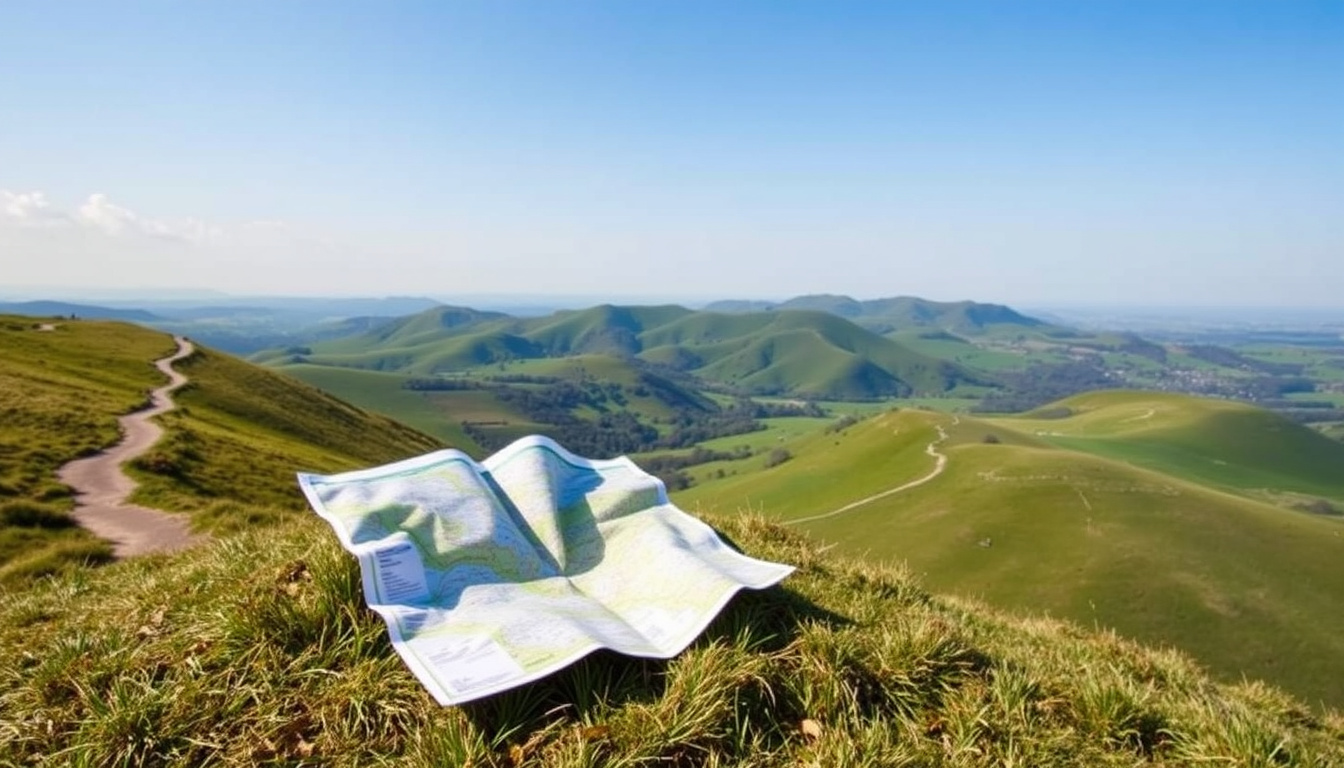
Rising abruptly from the Severn Valley, the Malvern Hills form a narrow ridge of ancient volcanic rock that stretches for roughly 9 to 10 miles across the borderlands of Worcestershire, Herefordshire, and a sliver of northern Gloucestershire. Designated an Area of Outstanding Natural Beauty since 1959, this landscape draws walkers, cyclists, and nature enthusiasts with its network of trails, panoramic viewpoints, and the promise of pure mineral water from historic springs.
The hills are not a single summit but a chain of peaks, the highest being Worcestershire Beacon at 425 metres. On a clear day, views extend across as many as 13 counties, taking in the Cotswolds, the Black Mountains, and even the distant Welsh peaks. The area is managed by the Malvern Hills Trust, a charity that balances public access with conservation across roughly 1,200 hectares of open common land.
Beyond its natural appeal, the name “Malvern Hills” carries multiple meanings. It refers to the geological ridge itself, to the local government district that covers much of the surrounding area, and even to a climbing rose cultivar introduced in 1995. This guide brings together practical information on walking routes, maps, weather, council services, property, and the famous rose — creating a single resource for anyone planning a visit or simply curious about the region.
What are the best things to do in the Malvern Hills?
The Malvern Hills span Worcestershire, Herefordshire, and Gloucestershire. Nearest towns: Great Malvern, Malvern Link. Multiple car parks and public transport options.
Walking, cycling, horse riding, running, birdwatching, photography. Over 30 miles of trails from gentle walks to strenuous hikes (e.g., Worcestershire Beacon).
Best visited late spring–early autumn. Weather can change rapidly; check forecast. Average summer high 20°C, winter lows 2°C.
A climbing rose cultivar named after the hills, known for pale pink flowers and strong fragrance. Ideal for garden arches and walls.
Key insights about the Malvern Hills:
- The Malvern Hills are a designated Area of Outstanding Natural Beauty (AONB), covering around 1,000 hectares.
- The highest point is Worcestershire Beacon at 425 metres (1,394 ft), offering panoramic views of up to 13 counties.
- The hills are managed by the Malvern Hills Trust, a charity that balances public access with nature conservation.
- Malvern water from the hills was famously used in the 19th century for hydrotherapy, leading to the town’s popularity as a spa resort.
- The ‘Malvern Hills’ rose was introduced in 1995 by David Austin Roses, a UK breeder, and has since become a garden favourite.
| Category | Details |
|---|---|
| Location | Worcestershire, Herefordshire, Gloucestershire, England |
| Highest point | Worcestershire Beacon (425 m / 1,394 ft) |
| Area | Approx. 1,000 hectares (2,471 acres) |
| Designation | Area of Outstanding Natural Beauty (since 1959) |
| Managing body | Malvern Hills Trust |
| Nearest railway station | Great Malvern (direct trains from London Paddington, Birmingham, Hereford) |
| Postcode area | WR14 (Great Malvern); multiple postcodes across hills |
| Rose cultivar | Malvern Hills (David Austin, 1995) – climbing rose, pale pink |
Walking and hiking trails
The Malvern Hills offer routes for all abilities. The End-to-End Walk covers 9.3 miles along the ridge and is doable in a single day. The British Camp Route is a 5.8-mile there-and-back walk from the Upper Wyche car park, passing Perseverance Hill, Jubilee Hill, Pinnacle Hill, and Black Hill before reaching the Iron Age British Camp fort. For those seeking quieter ambles, the low wooded slopes on the western side provide gentler terrain. A free walking and cycling map and guide was launched in 2018, showing footpaths, bridleways, and 77 places to visit including cafés, pubs, heritage sites, and nature reserves. Printed copies are available from the Malvern Hills Trust offices, local Tourist Information Centres, cafés, and bike shops.
Cycling and horse riding
Cycling is permitted on designated bridleways and tracks across the hills, but not on footpaths. Horse riding is also allowed on the same routes. The Malvern Hills Trust publishes official maps showing which trails are open to bikes and horses. The 2018 free map and guide includes bridleway information alongside walking routes. Riders and cyclists should be mindful of the terrain — some sections are steep and rocky.
Scenic viewpoints and photography
Worcestershire Beacon is the most photographed summit, offering a 360-degree panorama. Other notable viewpoints include Herefordshire Beacon (the site of British Camp) and Sugarloaf Hill. On clear days, photographers can capture the Cotswolds, the Black Mountains, and the Welsh peaks in a single frame. The best light for landscape photography is early morning or late afternoon, particularly in spring and autumn when the low sun rakes across the ridge.
Family-friendly activities
Families can enjoy shorter, gentler walks on the lower slopes, picnicking on the commons, and visiting the Malvern Hills GeoCentre at Wyche. The GeoCentre offers interactive iPads covering geology, nature, and history, plus large wall maps. The hills also have several mineral water springs where visitors can fill bottles — a free and memorable activity for children.
Where are the Malvern Hills located and how do I get there?
The Malvern Hills run roughly north-south along the border between Worcestershire and Herefordshire, with a small section entering northern Gloucestershire. The nearest town is Great Malvern, located at the eastern foot of the hills. The ridge lies approximately halfway between Birmingham and Bristol, about 30 to 60 minutes from the Cotswolds, and roughly three hours from London by road or rail.
Interactive map and downloadable PDF
The Malvern Hills National Landscape website provides downloadable walking routes, GPX files for GPS devices, and links to the Malverns Walking App. The official Ordnance Survey Explorer 190 map covers the hills in detail. Digital tools and PDF guides are free to access, and printed maps are sold at visitor centres and outdoor shops in Great Malvern.
Postcodes for key access points
There is no single postcode for the entire Malvern Hills. For the main car park at the Wyche Cutting, use WR14 4EQ. For the Worcestershire Beacon car park, use WR14 4JJ. Great Malvern town centre falls under WR14 generally, while areas west of the hills use HR8 (Herefordshire) postcodes. Visitors should check the specific postcode of their intended car park before setting out.
Nearby towns and transport links
Great Malvern has a railway station with direct services from London Paddington, Birmingham, and Hereford. Bus services connect Malvern to Worcester, Ledbury, and Hereford. The M5 motorway (junction 7) is about 20 minutes east, and the A449 and A4104 run through the area. Car parks are located at several points along the eastern and western flanks of the hills, most charging a pay-and-display fee.
What is the Malvern Hills District Council responsible for?
The Malvern Hills District Council is the local government authority covering a large administrative area that includes the town of Malvern and many surrounding villages. Its responsibilities include housing, planning, waste collection, environmental health, leisure services, and electoral registration. The council is based at the Council House in Great Malvern and operates a full range of local government services.
Services provided by the council
The council handles council tax collection, benefits, business rates, licensing, planning applications, building control, and environmental protection. It also runs community services such as parks, playgrounds, and public toilets. For waste and recycling, the council provides kerbside collections and operates household recycling centres across the district.
How to contact the council
The Malvern Hills District Council can be reached via its website at malvernhills.gov.uk, by phone, or in person at the Council House in Great Malvern. The website offers online forms for common requests, planning portal access, and information about councillors and meetings. Contact details are published clearly on the site.
Planning and conservation efforts
The council works alongside the Malvern Hills Trust and the Malvern Hills National Landscape partnership to manage development and conservation within the AONB. Planning applications near the hills are subject to additional scrutiny to protect the landscape. The council also enforces regulations on public access, dog control, and littering on the hills.
The Malvern Hills Trust manages access and conservation on the hills themselves, while the Malvern Hills District Council handles broader local government services for the surrounding area. The hills also fall under Worcestershire County Council for highways and education, and small parts cross into Herefordshire and Gloucestershire.
What is the Malvern Hills rose and where can I buy one?
The Malvern Hills rose is a climbing rose cultivar introduced in 1995 by David Austin Roses, a well-known British breeder based in Shropshire. It produces pale pink, cup-shaped flowers with a strong, old-rose fragrance. The plant is vigorous and repeat-flowering, making it a popular choice for garden arches, walls, and trellises. It was named after the Malvern Hills themselves.
Origin and characteristics of the rose
The cultivar was developed by David Austin and launched in his 1995 catalogue. It is classified as a climbing rose, reaching heights of around 2.5 to 3 metres (8 to 10 feet) with a similar spread. The flowers are medium-sized, fully double, and appear in clusters from early summer through to autumn. The foliage is glossy and dark green, contributing to its overall garden appeal.
Growing tips and care
The Malvern Hills rose thrives in full sun to partial shade and prefers fertile, well-drained soil. Regular watering during dry spells and an annual feed in spring encourage healthy growth and abundant flowering. Pruning should be done in winter or early spring, removing dead or crossing stems and training new shoots to the support structure. It is generally disease-resistant, though routine checks for black spot and aphids are advisable.
Where to purchase the Malvern Hills rose
The most direct source is David Austin Roses, whose website offers bare-root and container plants for delivery across the UK. Many garden centres in Worcestershire and neighbouring counties stock the variety, especially those specialising in David Austin cultivars. Online retailers and plant nurseries also list it, though availability may vary seasonally. Local gardening groups or the Worcestershire Rose Society may provide additional sourcing advice.
The Malvern Hills rose is a climber, not a shrub rose. When purchasing, confirm you are buying the climbing form. David Austin also produces a separate shrub rose called ‘Malvern’ — the two are different cultivars. The climbing ‘Malvern Hills’ is the one named after this landscape.
Are there houses for sale in the Malvern Hills area?
Properties within the Malvern Hills AONB and its surrounding settlements are periodically available through standard UK property portals. The most active markets are in Great Malvern, Malvern Link, West Malvern, and Malvern Wells, with additional listings in Herefordshire villages such as Colwall and Mathon. No specific active listings are maintained by the Malvern Hills Trust or local councils.
Current property listings overview
Major property websites such as Rightmove, Zoopla, and OnTheMarket list houses for sale in the Malvern area. Searches using postcodes WR14 (Great Malvern), HR8 (Ledbury and surrounding villages), and WR13 (Malvern Wells and Colwall) return the most relevant results. House prices in the area tend to be above the national average, reflecting the desirability of the AONB location, but exact figures fluctuate with market conditions. A local estate agent can provide the most current picture.
Popular villages and neighbourhoods
Great Malvern offers a mix of Victorian townhouses, flats, and modern homes close to shops, schools, and the railway station. West Malvern, on the western slope of the hills, features larger detached properties with direct access to the ridge. Malvern Wells and Little Malvern are quieter villages with period cottages and rural homes. Across the hills in Herefordshire, Colwall and Mathon offer village amenities and scenic countryside settings.
Tips for buying in an Area of Outstanding Natural Beauty
Purchasing property within an AONB may involve additional planning restrictions, particularly for alterations, extensions, or new builds. Conservation areas and listed buildings are common in the historic parts of Malvern. Buyers should work with solicitors familiar with AONB regulations and check whether any rights of way cross the property. The Malvern Hills District Council’s planning portal provides guidance on permitted development rights within the protected landscape.
No official house price data specific to the Malvern Hills ridge itself is maintained by the Malvern Hills Trust or District Council. All figures cited in this article reflect general market observations for the WR14 and HR8 postcode areas. Buyers should consult current listings and local estate agents for accurate, up-to-date pricing.
What is the weather forecast for the Malvern Hills today?
No real-time weather data is provided by the Malvern Hills Trust or any single official page. The most reliable source for current conditions and forecasts is the Met Office, which covers the Malvern area in detail. Visitors should check the forecast shortly before setting out, as conditions on the exposed ridge can differ significantly from the valley below.
Seasonal weather patterns
Spring (March to May) brings increasing warmth and longer daylight hours, though rain and cool winds are common on the summits. Summer (June to August) is the most popular visiting period, with average highs around 20°C, but afternoon thunderstorms can develop quickly. Autumn (September to November) offers crisp, clear days and excellent visibility from the viewpoints. Winter (December to February) sees temperatures often dropping to 2°C or below, with frost, fog, and occasional snow making trails slippery.
Live weather resources and webcams
The Met Office forecast for Malvern provides hourly and 7-day outlooks. Local webcams are occasionally run by tourism sites or accommodation providers, but no permanent official webcam exists on the hills. For real-time trail conditions, follow the Malvern Hills Trust on social media, where rangers post updates on path status, car park capacity, and weather warnings.
What to wear and pack for a visit
Layered clothing is essential, as summit temperatures can be 5°C to 10°C cooler than the base. Waterproof and windproof outer layers are recommended even on fair days. Sturdy walking boots or shoes with good grip are advised for the rocky sections, especially after rain. Sunscreen, a hat, and plenty of water are necessary in summer, while a head torch and extra layers may be prudent on shorter winter afternoons.
How has the Malvern Hills landscape evolved over time?
The Malvern Hills have a deep geological and human history. The timeline below outlines the key stages of their formation and cultural significance.
- ~600 million years ago — Precambrian rocks of the Malvern Hills formed, some of the oldest in England.
- Iron Age — Hill forts built on summits (e.g., Herefordshire Beacon – British Camp).
- Medieval period — Monks and pilgrims visited the holy springs; Malvern Priory established.
- 19th century — Malvern water becomes famous for its purity, leading to a spa boom; hydrotherapy centres built.
- 1925 — Malvern Hills Conservators (now Malvern Hills Trust) established to protect the hills.
- 1959 — Designated an Area of Outstanding Natural Beauty.
- 1995 — David Austin introduces the ‘Malvern Hills’ rose variety.
- Present — Managed by the Trust, offering public access and conservation. Over 1 million visitors annually.
What is known about the Malvern Hills and what remains unclear?
Most geographical and administrative facts about the Malvern Hills are well established, but some queries — particularly around property data and the rose cultivar — have limits to the available information.
| Established information | What remains unclear |
|---|---|
| The Malvern Hills are a ridge of hills, not a mountain range. | Exact house prices fluctuate and depend on current market data. |
| The ‘Malvern Hills’ rose is a specific climber sold by David Austin Roses. | No single official postcode covers the entire hill range. |
| Postcodes vary across the hills; no single ‘Malvern Hills postcode’ exists. | Real-time weather data is not provided by the Hills Trust itself. |
| Cycling is permitted on designated bridleways but not on footpaths. | Some niche rose cultivars linked to the area may exist but are not well documented online. |
Why do the Malvern Hills matter beyond their scenery?
The hills are a significant economic driver for the region. Visitor spending supports local pubs, cafés, B&Bs, and outdoor shops in Malvern and the surrounding villages. The area also faces conservation challenges — balancing growing visitor numbers with protection of fragile habitats, archaeological sites, and the need to manage erosion, dog waste, and parking pressure requires ongoing coordination between the Trust, the council, and local communities.
Culturally, the hills have inspired writers and composers for generations. J.R.R. Tolkien taught in Malvern and drew on the landscape in his works. C.S. Lewis visited, and the composer Edward Elgar, a Worcestershire native, found inspiration in the hills. The Malvern Hills rose phenomenon adds a horticultural dimension, connecting a gardening audience to the geographical name and creating a bridge between two distinct search communities.
What do key sources say about the Malvern Hills?
“The Malvern Hills are in the English counties of Worcestershire, Herefordshire and a small area of northern Gloucestershire, dominating the surrounding countryside.”
“Plan your visit to the Malvern Hills and Commons, including walking, cycling, horse riding, free maps, visitor guides and information.”
“A beautiful climbing rose with pale pink, cup-shaped flowers and a strong, old rose fragrance. Named after the stunning Malvern Hills in Worcestershire.”
How can I stay updated about the Malvern Hills?
For the most current information on trail conditions, events, conservation updates, and visitor guidance, check the Malvern Hills Trust website and follow their social media channels. The Visit the Malverns tourism site publishes seasonal highlights, accommodation deals, and an events calendar. Local estate agents provide the latest property listings across the WR14, WR13, and HR8 postcodes, and the Met Office remains the best source for up‑to‑date weather forecasts before any trip.
Frequently asked questions about the Malvern Hills
Can I cycle on the Malvern Hills?
Yes, but only on designated bridleways and tracks. Cycling is prohibited on footpaths to protect the terrain and other visitors. Check the trust’s cycling map.
Are dogs allowed on the Malvern Hills?
Yes, but dogs must be kept under control and on leads near livestock. Please clean up after your dog.
Is there an entrance fee for the Malvern Hills?
No. Access to the hills is free. However, most car parks charge a fee (pay and display).
What is the easiest walk on the Malvern Hills?
The route along the Worcestershire Beacon from Great Malvern is popular and relatively easy (approx. 3 miles round trip with some inclines). There are also flat sections on the western side.
Where can I find accommodation near the Malvern Hills?
Great Malvern and Malvern Wells offer hotels, B&Bs, and guesthouses. Self-catering cottages are available in surrounding villages. See Visit the Malverns for listings.
What is the Malvern Hills postcode for navigation?
For the main car park at the Wyche Cutting, use WR14 4EQ. For the Worcestershire Beacon car park, use WR14 4JJ. Different entrances have different postcodes.
Are there guided tours or walks?
The Malvern Hills Trust occasionally offers guided walks; check their events page. Local walking groups also organise outings.
Can I buy the Malvern Hills rose locally?
Yes – David Austin Roses is based in Albrighton, Shropshire, but many garden centres in Worcestershire stock the variety. Online purchase is widely available.

Oliver Arthur Morgan Harrison is a staff writer for StoryShift.uk, covering UK news, culture, politics and technology. He works under Editor-in-Chief Maarika Tamm and UK Managing Editor Oliver Grant, following the newsroom standards for sourcing, verification and fact-checking set out in our editorial policies.