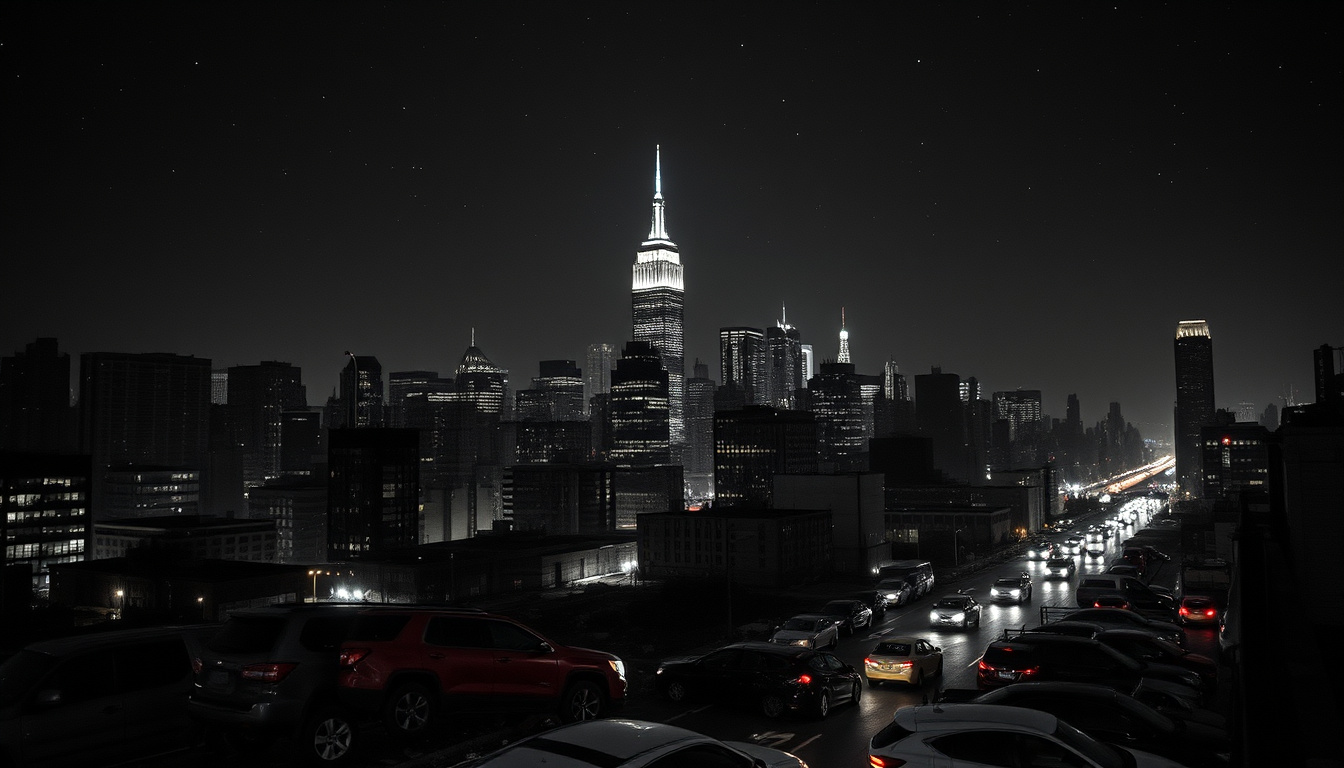
On the evening of July 13, 1977, New York City plunged into darkness. The outage that followed lasted more than 25 hours, paralyzed the city’s infrastructure, and left millions without power during a brutal summer heat wave. What began as a lightning strike on a single substation escalated into one of the most destructive nights in the city’s modern history.
The blackout exposed deep vulnerabilities in the metropolitan power grid while triggering widespread looting, hundreds of fires, and thousands of arrests. The economic damage alone reached into the hundreds of millions of dollars. For a city already struggling through a fiscal crisis, the event delivered a severe blow to civic confidence.
The events of those two July nights have since become a reference point for understanding how infrastructure failures can cascade into social chaos. Officials at the time scrambled to restore order while assigning blame, and the aftermath prompted lasting changes to utility operations and emergency planning across the Northeast.
What Caused the 1977 New York City Blackout?
The chain of events began at 8:34 p.m. when lightning struck the Buchanan South substation on the Hudson River. Two circuit breakers tripped, interrupting the flow of power from the Indian Point nuclear station, which at the time supplied approximately 900 megawatts to the metropolitan grid. According to official accounts, a loose locking nut and a slow reclosing mechanism prevented the system from recovering automatically, allowing the fault to propagate across Con Edison’s network.
The failure did not remain isolated. Within minutes, the outage cascaded through interconnected transmission lines, overwhelming backup systems designed to contain localized faults. Unlike the 1965 Northeast blackout, which resulted from a transmission line relay malfunction during peak demand, the 1977 event struck during a period of lower overall consumption, meaning neighboring regions had capacity to spare. Yet the initial fault spread so rapidly that regional coordination could not prevent the citywide collapse.
Mayor Abraham Beame publicly accused Con Edison of “gross negligence,” while the utility initially attributed the failure to an act of God. The disagreement over culpability dominated the public discourse in the weeks following the event and fueled congressional scrutiny of utility practices across the country.
The incident highlighted how a single point of failure, compounded by delayed automatic recovery systems, could destabilize an entire regional grid. Subsequent investigations pointed to the absence of rapid reclosing mechanisms as a critical design flaw.
Key Insights from the Incident
- Lightning trigger: A single bolt at the Buchanan South substation initiated the failure chain
- Equipment failure: A loose locking nut prevented automatic system recovery
- Cascade effect: The fault spread across multiple boroughs within minutes
- Night onset: Darkness fell at 9:43 p.m., well after business hours, leaving stores undefended
- Heat wave conditions: Mid-90s temperatures without cooling systems heightened health risks
- Fiscal crisis backdrop: The city was already near bankruptcy, compounding public distress
- Limited backup isolation: The grid lacked sufficient mechanisms to segment failures before they spread
| Fact | Details |
|---|---|
| Initial Trigger | Lightning strike at Buchanan South substation |
| Time of Strike | 8:34 p.m. EDT, July 13, 1977 |
| Full Blackout | 9:43 p.m. EDT |
| Power Restored | 10:14 p.m., July 14, 1977 |
| Total Arrests | 3,776–4,500 looters |
| Fires Reported | 1,037 (14 multiple-alarm) |
| Stores Damaged | 1,616 |
| Economic Damage | $300 million–$1 billion |
| Police Calls | 67,000 (four times normal volume) |
| Civilian Injuries | 436–204 (overlapping counts) |
| Police Injuries | 550 officers |
| Civilian Deaths | 2 (blackout-related) |
When Did the Lights Go Out and How Long Did It Last?
The sequence unfolded with striking speed. At 8:34 p.m., lightning disabled the substation near Indian Point. Approximately one hour and nine minutes later, at 9:43 p.m., the blackout became complete, spreading across all five boroughs with the exception of southern Queens, which drew power from the Long Island Lighting Company and remained unaffected. A handful of large complexes equipped with independent generators, including Pratt Institute, also maintained service.
The outage persisted for 25 hours and 31 minutes, officially ending around 10:14 p.m. on July 14. During that time, the city endured temperatures in the mid-90s Fahrenheit combined with high humidity, conditions that made the loss of air conditioning and water pumps particularly dangerous for vulnerable residents.
Immediate Aftermath on July 13–14
Within moments of the lights going out, the city’s transit system froze. Approximately 4,000 subway passengers required evacuation as trains halted in tunnels where ventilation systems had also lost power. Both LaGuardia and JFK airports suspended operations for roughly eight hours. Road tunnels closed due to the failure of ventilation fans, snarling traffic and preventing emergency vehicles from moving freely.
Governor Hugh Carey dispatched state police to assist an overwhelmed NYPD and FDNY. Mayor Beame, who was in the Bronx when the blackout began, navigated darkened streets to reach City Hall, where he coordinated an emergency response with roughly 25,000 municipal workers—though half could not reach their posts due to the collapsed transit network.
Southern Queens remained powered throughout the event because it received electricity from a separate utility. Properties with backup generators also retained service, highlighting the value of distributed power sources during grid failures.
What Happened During the 1977 NYC Blackout?
The social consequences of the outage far exceeded mere inconvenience. Within hours, opportunistic looting erupted across more than 30 neighborhoods, concentrating in areas such as Bushwick, Williamsburg, Harlem, and Crown Heights. The pattern differed markedly from the 1965 blackout, which struck in late afternoon when many merchants were still present to protect their property and neighbors demonstrated mutual assistance. By contrast, the 1977 event began after business hours, leaving storefronts abandoned and undefended.
Organized groups quickly exploited the situation. In one documented example, individuals drove cars into storefront grates to wrench them open before loading merchandise into vehicles. A Bronx dealership lost 50 Pontiacs. In Bushwick, the intersection of Broadway and Myrtle Avenue became a scene of widespread arson, with 25 fires still burning the following morning. Across 35 Brooklyn blocks, 134 stores were hit, of which 45 burned.
Scale of Destruction and Disorder
The combined damage extended far beyond any single neighborhood. In total, 1,616 commercial establishments suffered looting or arson. Firefighters responded to 1,037 separate fire calls, including 14 that required multiple alarm units. Many blazes burned out of control for extended periods because emergency crews could not reach them through blocked streets.
Arrests reached a scale never before seen in the city’s history. Between 3,776 and 4,500 individuals were taken into custody, though some official counts place the figure closer to 3,000 when accounting for overlaps. Jails and precinct holding cells became severely overcrowded as police processed the sheer volume of suspects. The emergency call volume quadrupled, with the NYPD handling 67,000 calls in a single day.
The human toll included 550 injured police officers, 80 hurt firefighters, and between 204 and 436 civilians wounded. Two civilian deaths were directly attributed to blackout-related circumstances.
Medical professionals treating patients during those hours faced particular challenges treating heat-related illness without reliable power for cooling equipment and life-support systems. The combination of darkness and extreme temperatures created conditions that compounded risk for elderly and ill residents.
How Does the 1977 Blackout Compare to Other Major Outages?
Historians and utility analysts have frequently contrasted the 1977 New York blackout with two other major Northeast outages: the 1965 event and the 2003 widespread failure. Each incident offers distinct lessons about grid design, emergency response, and social behavior during infrastructure collapse.
1965 Northeast Blackout
The 1965 outage originated from a relay malfunction on transmission lines serving Niagara Falls, during a period of unusually high summer demand. The failure rippled across six states and two Canadian provinces within minutes. However, the timing played a critical role in limiting damage: the blackout struck in late afternoon, meaning many business owners were still present, neighborhood watch networks remained active, and the darkness provided cover for only a few hours before utility crews began restoration work. Community solidarity rather than disorder characterized the public response.
2003 Northeast Blackout
The 2003 event, triggered by overgrown trees contacting power lines in Ohio amid software failures that delayed human awareness, affected approximately 50 million people across the Midwest and Northeast. Like the 1977 case, it highlighted cascading vulnerabilities, but it unfolded more gradually and lacked the immediate civil chaos that marked New York’s experience. The later timing of initial failures and better regional coordination limited the duration of widespread disruption.
What Made 1977 Distinctive
Three factors set the 1977 blackout apart. First, the night onset meant that businesses had closed and merchants had departed, leaving property vulnerable. Second, a lingering fiscal crisis had strained city services and heightened social tensions, making segments of the population more willing to participate in disorder. Third, a heat wave added physical danger to the loss of power for cooling, water pumping, and transit.
Economically, the 1977 event caused an estimated $300 million to $1 billion in total damage, with roughly half attributed directly to looting and arson. When adjusted for inflation, that figure approaches $1.5 billion in contemporary dollars, making it one of the costliest infrastructure failures in American history at the time.
What Lessons Were Learned from the 1977 Blackout?
The blackout prompted extensive soul-searching among utility engineers, city administrators, and federal regulators. Con Edison’s internal assessment acknowledged vulnerabilities related to single points of failure and the inadequacy of automatic recovery mechanisms. The Federal Energy Regulatory Commission commissioned a detailed impact study that catalogued not only direct infrastructure damage but also the secondary costs of looting, arson, and emergency response.
- Improved breaker reliability: Utilities across the Northeast invested in upgrading circuit breakers and reclosing systems that could isolate faults faster and recover automatically.
- Regional coordination: The failure demonstrated that neighboring utilities needed better communication and coordination protocols to prevent localized faults from becoming regional catastrophes.
- Emergency planning: City officials developed more robust contingency plans for transit disruption, shelter operations, and mutual aid between jurisdictions.
- Social vulnerability recognition: Planners began incorporating awareness that infrastructure failures disproportionately affect communities already experiencing economic hardship or social stress.
- Heat wave protocols: The dangerous combination of power loss and extreme heat drove improvements in cooling center activation procedures and utility communication with health agencies.
Clarifying What Is Known and What Remains Uncertain
| Established Information | Information That Remains Unclear |
|---|---|
| Lightning strike triggered the initial fault at Buchanan South substation | The precise mechanical failure sequence that prevented automatic recovery |
| Full blackout began at 9:43 p.m. EDT on July 13 | Whether earlier intervention by utility operators could have contained the cascade |
| Power restored around 10:14 p.m. on July 14 | Exact number of arrests, with sources citing figures between 3,000 and 4,500 |
| Over 1,600 stores were damaged or looted | Total economic impact when accounting for indirect business losses |
| Mayor Beame accused Con Edison of gross negligence | Specific internal communications that preceded the incident |
| Governor Carey sent state police to assist | Long-term health outcomes for individuals injured during the event |
Historical Context and Social Significance
The blackout did not occur in isolation. New York City in 1977 was in the grips of a severe fiscal crisis that had brought the municipal government to the edge of bankruptcy. A decade of industrial decline, white flight to the suburbs, and rising welfare costs had hollowed out the tax base. Mayor Beame’s administration was implementing austere budget cuts that had already damaged morale across city services.
Against this backdrop, the sudden loss of electricity acted as a catalyst for latent social tensions. Urban historians have noted that the contrast between the 1965 and 1977 blackouts illustrates how economic conditions shape public responses to infrastructure failures. During the earlier event, neighbors in many areas formed impromptu patrols and shared resources. By 1977, frustration with deteriorating services and persistent inequality had curdled into something closer to collective anger.
The heat wave that coincided with the blackout intensified the psychological pressure. Temperatures in the mid-90s made darkened apartments unbearable, driving people into streets where the absence of lighting and police presence created opportunities for disorder. Some observers noted anecdotal increases in births approximately nine months later, though comprehensive data on that phenomenon remains limited.
Official Statements and Primary Sources
Mayor Abraham Beame accused Con Edison of “gross negligence” in the aftermath, while the utility attributed the failure to an act of God, triggering a public dispute over responsibility that echoed through congressional hearings in the following months.
— Contemporary news reports cited in the FERC Impact Assessment of the 1977 New York City Blackout
The blackout of 1977 was distinguished from its predecessors by the scale of civil disorder that accompanied it. While the 1965 event had seen communities band together, the 1977 night unfolded against a backdrop of fiscal crisis and urban tension that amplified mob psychology and created conditions for widespread looting.
— EBSCO research summary on power and energy incidents
Primary source documentation for the event includes the Federal Energy Regulatory Commission’s “Impact Assessment of the 1977 New York City Blackout,” which compiled detailed statistics on fires, arrests, property damage, and emergency response workloads. Congressional testimony and contemporary newspaper archives supplement this record.
Summary
The 1977 New York City blackout remains a defining case study in infrastructure resilience and social vulnerability. A lightning strike, compounded by equipment failure, plunged nine million people into darkness for more than a day. The resulting chaos—widespread looting, hundreds of fires, thousands of arrests—exposed how quickly technical breakdowns can cascade into civil disorder when economic distress and extreme weather coincide.
The event reshaped utility engineering practices, emergency planning, and regional coordination protocols across the Northeast. For urban planners and energy engineers, the night of July 13, 1977, continues to offer lessons about the interdependence of infrastructure, social conditions, and public safety. Those seeking broader context on historical events affecting urban communities may find additional perspectives in the Wilts and Glos Standard – History Archives and Research Guide or the Cast of Red Riding – Actors and Roles in 1974, 1980, 1983 for related historical documentation.
Frequently Asked Questions
What caused the 1977 New York City blackout?
A lightning strike at the Buchanan South substation at 8:34 p.m. on July 13 tripped two circuit breakers, and equipment failure prevented automatic recovery, causing a cascading grid failure across the city.
How long did the 1977 blackout last?
The outage lasted 25 hours and 31 minutes, from 9:43 p.m. on July 13 until approximately 10:14 p.m. on July 14.
Was there looting during the 1977 NYC blackout?
Yes. Widespread looting occurred across more than 30 neighborhoods, with over 1,600 stores damaged or looted. Organized groups used vehicles to rip open storefronts.
How many arrests were made during the 1977 blackout?
Between 3,776 and 4,500 individuals were arrested, representing the largest mass arrest in New York City history at that time.
How does the 1977 blackout compare to the 1965 Northeast blackout?
The 1965 event struck during late afternoon with merchants present and neighbors available to assist, resulting in solidarity rather than chaos. The 1977 blackout occurred after business hours on a summer night during a fiscal crisis, leading to widespread looting and arson.
Who was mayor during the 1977 blackout?
Abraham Beame was mayor of New York City at the time. He navigated darkened streets to reach City Hall and publicly accused Con Edison of “gross negligence.”
What lessons were learned from the 1977 blackout?
Utilities improved breaker reliability and reclosing mechanisms. Officials developed better emergency protocols for transit shutdowns, mutual aid between jurisdictions, and recognition that economic distress can amplify infrastructure failures.
What was the economic damage from the 1977 blackout?
Damage estimates ranged from $300 million to $1 billion, with roughly half attributed directly to looting and arson. Adjusted for inflation, the congressional estimate approaches $1.5 billion in contemporary dollars.

Oliver Arthur Morgan Harrison is a staff writer for StoryShift.uk, covering UK news, culture, politics and technology. He works under Editor-in-Chief Maarika Tamm and UK Managing Editor Oliver Grant, following the newsroom standards for sourcing, verification and fact-checking set out in our editorial policies.